The draft bill to partially amend the National Pension Law and related laws, aimed at strengthening the functionality of the pension system based on social and economic changes, was approved by the Cabinet on May 16, 2025, and will proceed to deliberation in the Diet.
This amendment aims to respond to the diversity in work styles, lifestyles, and family structures, while also striving to enhance life stability and secure income for both current and future pension recipients.
Below, HSB JAPAN will help you summarize the contents and expected implementation dates for each part.

I. Overview of the Pension System Amendment Draft and Implementation Dates
According to the official website of Japan's Ministry of Health, Labor and Welfare, this amendment draft includes many items, with the main notable points being:
- Expansion of social insurance coverage (abolition of the 1.06 million yen income threshold)
- Review of the pension system for working seniors
- Review of the survivor's pension system
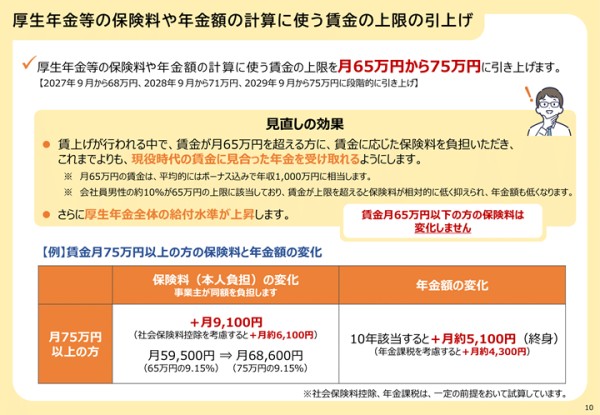
- Increase in the salary cap used for insurance and pension calculations
- Review of child dependency allowance
Note that the implementation dates for each amendment differ.
Regarding the objective of this reform, the Ministry explained:
"Based on changes in society and the economy, the amendment aims to enhance the functions of the pension system by building a system neutral to work styles and gender differences, while reflecting diversity in lifestyles and family structures. Through strengthening income redistribution functions and expanding the private pension system, the ultimate goal is to ensure a stable life for the elderly."
1. Expansion of Social Insurance Coverage – Abolition of the "1.06 Million Yen Barrier"
The Japanese government will review the conditions for participating in pension and health insurance for short-hour workers such as part-time employees at small and medium-sized enterprises, as well as workers at individual business establishments.

Currently, the conditions for part-time or short-hour workers to be eligible for social insurance include:
- Prescribed weekly working hours
- Salary level (88,000 yen/month or more)
- Company size (50 or more employees)
- Not being a student
In this reform, the above conditions will be simplified.
Specifically, first and foremost is the abolition of the salary condition (88,000 yen/month or more).
This change aims to address the so-called "1.06 million yen/year income barrier" that many workers are concerned about. The abolition of this condition will be decided based on the increase in minimum wages across local municipalities nationwide, and is expected to be implemented on a date specified by ordinance within 3 years of the law's promulgation.
This means:
Working 20 hours or more per week will be sufficient to qualify for social insurance, regardless of salary.
However, in the context of continuously rising minimum wages, if workers want to work 20 hours or more per week while keeping their salary below 88,000 yen/month, they would have to accept an hourly wage below 1,015 yen – which is practically unrealistic. Therefore, in essence, this salary condition has effectively become obsolete.

Next, the company size condition will also be phased out gradually.
Currently, only workers at companies of a certain size are eligible for social insurance. However, within the next 10 years, this requirement will be narrowed and gradually abolished, so that ultimately, any worker working 20 hours or more per week can participate in insurance, regardless of where they work.
Specifically, the implementation milestones by company size are:
- Companies with 36-50 employees: from October 2027
- 21-35 employees: from October 2029
- 11-20 employees: from October 2032
- Under 10 employees: from October 2035

Additionally, expansion of application to individual business establishments.
Currently, only individual business establishments that regularly employ 5 or more people in 17 specific industries are subject to social insurance. However, from October 2029, all individual business establishments with 5 or more employees, regardless of industry, will be mandatorily covered.
However, for establishments that existed before October 2029, there will be transitional measures to temporarily exempt them from mandatory application.
The government is also considering support measures for both workers and employers:
- For businesses, employers who increase working hours or raise wages to improve employee income will receive financial support through career-up subsidies (キャリアアップ助成金), expected to be implemented in fiscal year 2025 with a maximum of 750,000 yen per person.
- For workers, to reduce the financial burden when first starting to participate in insurance, there will be temporary measures lasting 3 years, allowing reduction of the insurance contribution rate as prescribed by the government.
Note: These support measures may be temporary, so further detailed information from the government should be monitored.
2. Review of the Pension System for Working Seniors (在職老齢年金制度)
In the context of an increasing number of seniors receiving pensions while continuing to work, and to address labor shortages, the Japanese government will review the pension system for working seniors.
Currently, the pension system for working seniors is a mechanism that reduces pension benefits for those who receive a certain level of income from employment.
Specifically, under current regulations:
If total monthly income (including bonuses averaged over 12 months) plus the pension amount received from Employees' Pension Insurance (厚生年金) exceeds 500,000 yen, then half of the excess amount will be suspended (deducted).

In the upcoming amendment, the income threshold for pension reduction will be raised from 500,000 yen to 620,000 yen.
The 620,000 yen threshold is set based on the image of workers continuing to work with the average salary of those in their 50s, while still receiving a pension.
Implementation timing for this change is expected to begin from April 2026.
3. Review of the Survivor's Pension System (遺族年金の見直し)
Survivor's pension is a benefit paid to the family of a person who was enrolled in Employees' Pension Insurance (厚生年金保険) or National Pension (国民年金) when that person passes away.
Survivor's pension includes "basic survivor's pension" (遺族基礎年金) and "survivor's welfare pension" (遺族厚生年金), with differences in payment conditions and eligible recipients.
The reform of the survivor's welfare pension primarily aims to eliminate gender disparities.
Under the current system, there are differences in conditions and payment periods for childless spouses depending on gender.

After the reform:
- Spouses under 60 without children (specifically, those aged 20 to 50 without children under 18) will become eligible to receive time-limited benefits for 5 years.
- At the same time, childless men under 55 – who were previously not eligible – will also become new recipients.
The policy will also include adjustments to support time-limited recipients, such as:
- Increasing old-age pension through the division of pension benefits at the time of death (called "death division").
- Establishing a new supplementary allowance for time-limited recipients.
- Abolishing the income requirement, meaning recipients will receive benefits regardless of income level.
Additionally, for cases requiring special consideration, there will be a mechanism allowing continued payment after the 5th year.
Note that:
Those already entitled to benefits, individuals over 60, or those aged 20 to 50 with children under 18, will continue to be subject to the current system.
These reforms are expected to be implemented gradually over 20 years starting from April 2028.
Regarding the basic survivor's pension (遺族基礎年金): It will be adjusted so that children can receive benefits, regardless of the status of the guardian.

Specifically, children will still receive benefits in the following cases:
- Parent remarries.
- Parent's income exceeds the prescribed limit.
- Child is adopted by a blood relative.
- After a parent passes away, the surviving parent (who had previously divorced) takes custody.
As a result, children will not lose their right to benefits due to circumstances beyond their control and choice.
4. Increase in the Salary Cap for Insurance and Pension Calculations
In the Employees' Pension Insurance system (厚生年金), insurance premiums and pension amounts are calculated based on the worker's salary (remuneration). However, there is a ceiling (upper limit) on the standard monthly salary (標準報酬月額) – which serves as the basis for calculating these amounts.
Currently, the upper limit of the standard monthly salary is 650,000 yen.
For those with income higher than this limit, the actual insurance contribution rate relative to total income will be lower, resulting in contributions that are not proportional to actual salary.

The Ministry of Health, Labor and Welfare stated that the goal of this reform is:
"Ensuring that high-income earners contribute proportionally to their income, thereby increasing future pension benefits."
Specifically, the standard monthly salary ceiling will be increased gradually according to the following timeline:
- From 650,000 yen to 680,000 yen (effective from September 2027)
- Then to 710,000 yen (from September 2028)
- And finally to 750,000 yen (from September 2029)
This ceiling increase means that workers and businesses with high incomes will have to pay more in insurance premiums, but at the same time the pension amount received in the future will also increase.
5. Review of Child Dependency Allowance in the Pension System
In Japan's pension system, there is a mechanism to add supplementary benefits for pension recipients who are raising children.

Currently, this system is already in place, but in this reform, the child dependency allowance amount will be increased.
- Under the current rates (fiscal year 2024):
- First and second child: 234,800 yen/year
- From the third child onward: 78,300 yen/year
After the reform, each child will receive a fixed additional amount of 281,700 yen/year, regardless of birth order.
Notably, this adjustment will also apply to those currently receiving pensions, not only new recipients.
Furthermore, those who previously only received the basic old-age pension (老齢基礎年金) – which did not include the child dependency allowance – will also be eligible for this additional benefit after the reform takes effect.
These changes are expected to take effect from April 2028.
II. Other Major Reform Contents
In addition to the key reforms mentioned above, there are several other reform items as follows:
1. Review of Private Pension System
Regarding the individual defined contribution pension plan (iDeCo), under current regulations, only those enrolled in the National Pension and not yet receiving the basic old-age pension or iDeCo old-age benefits are eligible to participate. Therefore, depending on work style and personal circumstances, the maximum age for iDeCo participation currently differs.
For this reason, to make the system simpler and easier to understand, participation conditions will be expanded. Specifically, under the proposed reform, individuals aged 60 to under 70 who have not yet received basic old-age pension or iDeCo old-age benefits, and wish to continue accumulating assets for retirement through iDeCo, will be permitted to continue participating and contributing.
2. Review of the Lump-Sum Withdrawal Benefit System (脱退一時金制度)
The lump-sum withdrawal benefit system is specifically designed for foreign nationals, as they often have short residency periods and their insurance contributions are difficult to connect to future old-age pension benefits.
- Under current regulations, this benefit is paid as a one-time lump sum based on the insurance contribution period (maximum payment period of 5 years). However, when receiving this benefit, the previous contribution period becomes invalid, meaning it is not counted toward future pension benefits.
- However, as the residency period of foreign nationals in Japan continues to lengthen, there are plans to increase the maximum payment period from 5 years to 8 years.
- Additionally, for foreign nationals who are likely to live in Japan long-term in the future, if they depart Japan with a valid re-entry permit, during the validity period of that permit, they will not be permitted to request this lump-sum benefit.
3. Allowing Deferral of Pension Receipt for Survivor's Welfare Pension Recipients (遺族厚生年金受給権者)
Previously, those receiving survivor's welfare pension benefits were not permitted to defer their own old-age pension. However, due to the trend of increased elderly labor participation, to allow them the option to increase their pension amount by deferring receipt, it is expected that survivor's welfare pension recipients will also be allowed to register for deferral of old-age pension.
This regulation is expected to take effect from April 2028.
4. Extension of the National Pension Contribution Deferral System (国民年金の納付猶予制度の延長)
During the period until June 2030, eligibility for the National Pension contribution deferral system is determined based on the income of the individual and their spouse, regardless of the income of the head of household living together. Additionally, there is a mechanism allowing retroactive payment of contributions when the participant has the financial capacity to do so.
This time, this temporary measure is expected to be extended for an additional 5 years, allowing application until the end of June 2035.
5. Expansion of Voluntary Participation in National Pension for Elderly Individuals
For those who have not yet qualified for the basic old-age pension, they may continue voluntary participation after age 65 until they have completed the required contribution period. The scope of application is expected to be expanded to those born before April 1, 1975, and the application period of this system will be extended.
6. Extension of the Time Limit for Pension Benefit Division Requests upon Divorce
The time limit for requesting division of pension insurance records upon divorce is expected to be extended from 2 years to 5 years, in line with the extension of the time limit for property division claims under the Civil Code.
Therefore: If you do not intend to stay in Japan long-term, APPLY FOR YOUR NENKIN NOW to avoid losing your benefits due to a valid re-entry permit.