You have booked your flight, shipped your boxes, and said your goodbyes. The last thing on your mind is a form at the municipal office.
That form is the moving-out notification (tenshutsu todoke). If you are leaving Japan permanently, or moving abroad for an extended period, filing it is an important part of closing your resident registration.
It also matters when you apply for a Japanese pension lump-sum withdrawal payment (dattai ichiji kin). One of the eligibility requirements is that you no longer have a registered address in Japan when the Japan Pension Service receives your application.
If your resident record is still active, your application may be rejected even if you have physically left Japan.
This article explains what the moving-out notification does, why it matters for your pension refund, how to file it, and what to do if you have already left Japan without submitting it.
What the Moving-Out Notification Actually Does
When you leave Japan to live abroad, you generally need to submit a moving-out notification to the municipal office responsible for your registered address.
The notification removes your address from the Basic Resident Register (jumin kihon daicho), commonly referred to through your juminhyo, and records your move abroad.
The date recorded in the municipal system is important for your pension refund.
To qualify for a lump-sum withdrawal payment, you must no longer have a registered address in Japan when the Japan Pension Service receives your application. The date you cease to have an address in Japan is also relevant to the two-year application deadline.
If you submit your moving-out notification before departure, you normally provide your planned departure date. The municipality records the move accordingly.
This means the date you submit the notification and the date you officially move out are not necessarily the same.
Why the Japan Pension Service Cares
The lump-sum withdrawal payment is not available simply because you have left Japan. You must meet all the eligibility requirements, including:
- You are not a Japanese national.
- You are no longer covered by the National Pension or Employees' Pension Insurance.
- You have the required qualifying contribution or coverage periods.
- You have not completed the qualifying period for an old-age pension.
- You have never been entitled to certain Japanese public pension benefits.
- You no longer have a registered address in Japan.
- You submit your application within the applicable two-year period.
The Japan Pension Service checks whether you have a registered address in Japan when it receives your application.
If you have already filed your moving-out notification and your resident record has been deleted, the Pension Service can generally verify that information through the municipal records. In that situation, you generally do not need to submit separate evidence of the deletion of your Japanese address.
However, if your resident record is still active when the Pension Service receives your application, you do not meet the address requirement. Your application can be rejected.
This is why filing the moving-out notification is such an important step before applying.
How to File It Before You Leave
The procedure is generally straightforward if you are still in Japan.
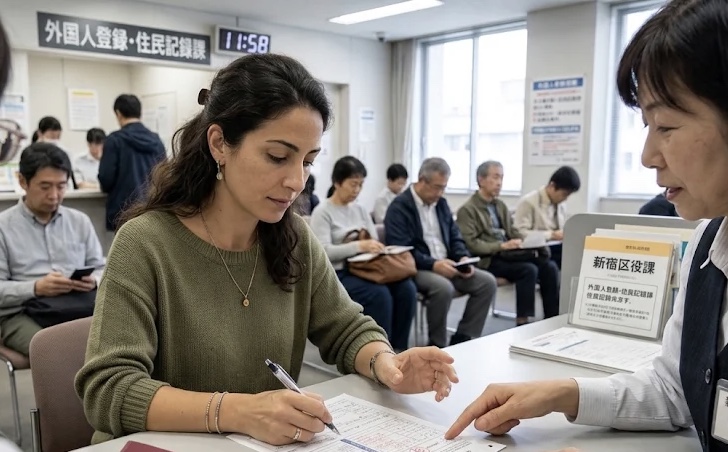
Visit the municipal office responsible for your registered address and submit a moving-out notification for an overseas move.
When should you submit it?
Many municipalities accept the notification from approximately 14 days before your planned departure.
The exact period and procedure depend on your municipality. Check its official instructions before visiting.
If you are leaving Japan for more than one year, a moving-out notification is generally required, regardless of your nationality.
If your stay abroad is expected to be less than one year, the notification is generally not required.
What documents do you need?
Requirements vary, but you should generally prepare:
- Identification, such as your residence card or passport.
- Your My Number Card, if you have one.
- Any additional documents requested by your municipality.
Foreign residents who hold a My Number Card generally need to return it when submitting an overseas moving-out notification. Its My Number functions are invalidated following the move-out procedure.
Some municipalities also require additional procedures involving National Health Insurance, long-term care insurance, or other municipal services.
Where should you file it?
The procedure is handled by your municipality's resident registration department.
Do not assume that every branch office can process overseas moving-out notifications. Some municipalities restrict these procedures to their main city hall or ward office, particularly for households that include foreign residents.
Check the correct office before making the trip.
What Happens If You Skip It?
The most important consequence is the potential problem with your pension refund.
If your resident record remains active when the Japan Pension Service receives your application, you may fail the requirement of having no registered address in Japan.
Leaving the country, cancelling your apartment, or handing back your residence card does not automatically guarantee that your resident registration has been deleted.
There can also be consequences for other administrative procedures.
For example, if you are enrolled in National Health Insurance, failing to complete the necessary municipal procedures can create problems with your insurance status and premium calculations.
The important point is that leaving Japan and completing the administrative procedures associated with moving abroad are not the same thing.
If You Have Already Left Japan
If you departed without submitting the moving-out notification, do not assume that it is too late to correct the situation.
Some municipalities accept overseas moving-out notifications by mail. Others may have additional requirements or restrictions.
Depending on the municipality, you may be asked to provide:
- A completed moving-out notification form.
- A copy of an identification document.
- Your previous Japanese address and the date you actually moved abroad.
- Your overseas contact address.
- A self-addressed envelope or other documents specified by the municipality.
If someone in Japan submits the notification on your behalf, a power of attorney may also be required.
The procedure is not identical across Japan. Contact the resident registration department of your former municipality and explain that you have already moved overseas and need to submit a moving-out notification retrospectively.
Do not assume that a generic mail-in procedure will be accepted by every city or ward office.
Will this affect your pension deadline?
Yes, potentially.
The pension lump-sum withdrawal application generally has to be submitted within two years of the date you no longer have an address in Japan.
The two-year period does not automatically restart when you finally submit your moving-out notification. Delayed paperwork does not give you a new two-year period.
If you have already left Japan, contact your former municipality as soon as possible and confirm the date that will be recorded for your overseas move.
If your pension deadline is approaching, do not wait until the municipal procedure is complete before seeking advice about your application.
The My Number Card: What Foreign Residents Need to Know
If you hold a My Number Card, you need to deal with it as part of your overseas moving-out procedure.
For foreign residents, the card generally has to be returned when the moving-out notification is submitted. Its My Number functions are invalidated following the move-out procedure.
This is different from the procedure for Japanese nationals, who may be able to continue using their My Number Card overseas if they complete the required procedure before leaving Japan.
Do not assume that the rules for Japanese nationals also apply to foreign residents.
If you have already left Japan and still hold your card, ask your former municipality how to handle it as part of the retrospective moving-out procedure.
What to Check Before You File
Before submitting your moving-out notification, check the following:
1. The departure date
Make sure the date you provide reflects when you will actually stop having an address in Japan. This date is important for determining the start of the two-year pension application period.
2. Your overseas address
Your municipality may ask for your new overseas address or destination country. Check the form's requirements before submitting it.
3. Your identification
Prepare your residence card, passport, and My Number Card if applicable. Foreign residents who hold a My Number Card generally need to return it as part of the overseas moving-out procedure.
4. Your other municipal procedures
Check whether you need to complete separate procedures for National Health Insurance, long-term care insurance, or other services before leaving.
5. Your pension refund eligibility
Make sure you meet the pension lump-sum withdrawal requirements. Having your resident record deleted is necessary for the address requirement, but it does not automatically make you eligible for a refund.
The Bottom Line
The moving-out notification is an important part of leaving Japan properly. It removes your Japanese address from the resident register and allows the Japan Pension Service to verify that you meet the no-address requirement for a lump-sum withdrawal payment.
If you are still in Japan, complete the procedure before departure whenever possible.
If you have already left without filing it, contact your former municipality immediately and ask whether you can submit the notification by mail.
Most importantly, remember that the pension application deadline is generally two years from the date you no longer have an address in Japan. Filing the moving-out notification late does not extend that deadline.
For assistance with Japanese pension refunds, moving-out procedures, or checking whether you meet the eligibility requirements, contact HSB JAPAN for a professional consultation.