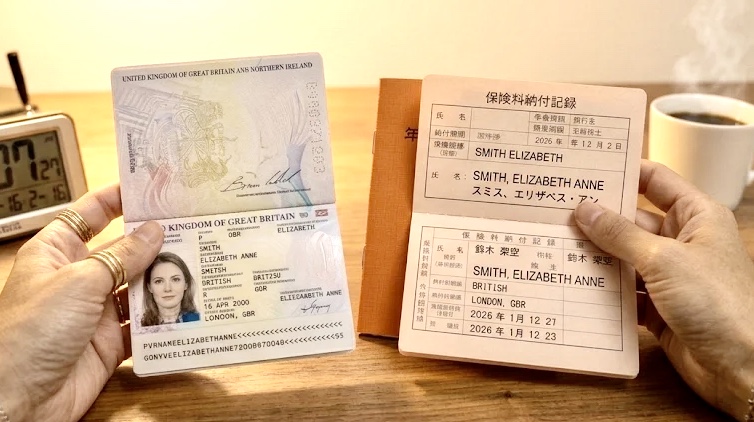
You filled in your Japanese pension refund application correctly. You meet the eligibility requirements, and your documents appear complete. Then you discover that a detail you overlooked could delay your payment: the name registered on your bank account differs from the name on your passport.
This can happen more easily than you might expect. Middle names may be omitted, surnames may appear in a different order, and Japanese banks generally register foreign customers' names in katakana.
The important requirement is that the bank account designated to receive your pension refund must belong to you. The Japan Pension Service (JPS) needs to verify that the person receiving the money is the same person making the claim.
This article explains the naming differences that can cause complications, what the official requirements actually say, and how to check your bank details before submitting your application.
Why the Name on Your Bank Account Matters
The Japan Pension Service requires information and supporting documentation confirming that the bank account designated for payment belongs to the claimant.
The application form asks you to provide the account holder's name, financial institution, branch, account number, and other relevant banking details. You must also submit bank-issued documentation confirming the account information.
The name entered on your application must be consistent with the name shown in the supporting bank documents.
The JPS also needs to establish that the account belongs to the person applying for the pension refund. If the names differ significantly, it may be necessary to provide additional information or documentation to clarify the discrepancy.
This does not mean that every difference between your passport and bank account automatically results in rejection. However, unexplained differences can complicate identity verification and delay the payment.
Form 1: The Middle Name Problem
Middle names are a common source of potential confusion, particularly for foreign residents who have opened bank accounts in Japan.
Consider this example:
Your passport shows:
JOHN MICHAEL SMITH
But your Japanese bank account is registered as:
JOHN SMITH
Or perhaps the bank has registered your name as:
JOHN M. SMITH
These differences can occur because banking systems have different name-registration conventions and character limitations.
The reverse situation is also possible. Your passport might show only a middle initial, while your bank account contains your full middle name.
Neither situation automatically makes the account unusable. However, if the names on your documents differ, the JPS may need clarification to establish that the account belongs to you.
Before applying, check how your name is registered with your bank and whether the supporting bank document clearly identifies you as the account holder.
Form 2: Different Name Orders
Names are not written in the same order in every country.
For example, a passport might display:
JOHN SMITH
A bank document might display:
SMITH JOHN
This can happen because some banking systems register the family name before the given name.
Japanese banks commonly use the family-name-first convention, while overseas banks may use the given-name-first convention.
A difference in name order does not automatically mean that the account belongs to someone else. However, the information entered on your pension application should follow the account details shown in the bank-issued documentation.
If the name order makes it difficult to establish that the account belongs to you, contact the Japan Pension Service before submitting the application.
Form 3: Katakana Versus Romanized Names
This is particularly relevant if you designate a Japanese bank account.
Foreign residents generally have their names registered with Japanese banks in katakana. Your passport, on the other hand, displays your name using Roman letters.
For example:
Passport:
JOHN MICHAEL SMITH
Japanese bank account:
ジョン・マイケル・スミス
This difference in writing systems is expected and is not automatically a problem.
The Japan Pension Service specifically requires the account holder's name to be registered in katakana when a Japanese financial institution is designated.
The application form also asks for the account holder's name in Roman letters, with a separate katakana entry for Japanese bank accounts.
Make sure the katakana spelling registered with your bank is correct and that the account belongs to you.
If the katakana spelling is significantly different from the pronunciation of your passport name, or if the bank has abbreviated your registered name, check with the bank and the JPS before applying.
Form 4: Name Changes
Another potential problem occurs when your legal name changes.
For example, you may have changed your surname after marriage or divorce, but your bank account may still be registered under your previous name.
Your passport might show:
JANE WILLIAMS
But your bank account might still show:
JANE SMITH
In this situation, the difference is more significant than a missing middle name or a different name order.
You should contact your bank to determine whether the account details can be updated. You may also need documentation establishing the connection between your previous and current legal names.
Depending on your circumstances, this could include a marriage certificate, divorce certificate, or another official name-change document.
The Japan Pension Service may request additional evidence to establish that the bank account belongs to the claimant. Do not assume that every type of document will automatically be accepted. Confirm the requirements with the JPS before submitting your application.
Form 5: Spacing, Hyphens, and Accents
Names can also look different when transferred between banking systems that use different character sets and registration conventions.
Examples include:
- A hyphenated surname appearing without the hyphen.
- An accented character such as é, ñ, or ü being replaced with an unaccented equivalent.
- A double-barrelled surname being shortened because of a character limitation.
- Spaces being inserted or removed between parts of a name.
These differences do not automatically invalidate a bank account or make it ineligible for receiving a pension refund.
However, if the bank document displays a name that differs from your identification, it is worth checking whether the difference could create difficulties when the JPS verifies the account.
The safest approach is to confirm the registered account-holder name with your bank and ensure that the information on your application accurately reflects the bank's records.
How to Check Before You Submit
Checking your documents before submitting your pension refund application can help avoid unnecessary delays.
Step 1: Check Your Passport
Read your passport's name carefully.
Note:
- Your given names.
- Your family name.
- Any middle names or initials.
- The order in which the names appear.
- Hyphens, spaces, and other characters.
Step 2: Check Your Bank Documentation
Obtain a bank-issued document confirming your account details.
Check:
- The account holder's registered name.
- The account number.
- The financial institution and branch.
- Whether the name is displayed in Roman letters or katakana.
For a Japanese bank account, confirm that your name is registered in katakana.
Step 3: Compare the Information
Check that the account-holder information on your bank document corresponds to the information you enter on the pension refund application.
Pay particular attention to middle names, name order, and differences caused by the bank's registration conventions.
Remember that the official requirement is not necessarily that every character on your passport and bank document must be identical. The important point is that the JPS can establish that the account belongs to you.
Step 4: Resolve Any Unclear Differences
If you find a discrepancy, consider the following options:
Ask your bank about correcting the registered name.
If your account contains an incorrect spelling or an outdated legal name, ask whether the bank can update it. This may require identification or other supporting documents.
Prepare supporting documentation.
If the difference is due to a legal name change or another legitimate reason, ask the JPS what additional documents it requires to establish your identity and the connection to the bank account.
Consider using another account.
If you have another eligible bank account registered in your own name, you may be able to designate that account instead. Check that it meets the JPS requirements before using it.
What Not to Do
Do not assume that every name difference is harmless.
A missing middle name or a different name order may be explainable, but you should not assume that the JPS will automatically understand the discrepancy.
Do not alter your bank certificate.
Bank documentation must accurately reflect the information held by the financial institution. Do not add handwritten corrections or change the document yourself.
If the information is incorrect, ask the bank to issue corrected documentation.
Do not assume that an explanation alone will be sufficient.
If your passport and bank documents show substantially different names, contact the JPS and ask what supporting evidence is required.
Do not wait until the application is returned to investigate.
If the JPS cannot verify the account information, it may request clarification or return an incomplete application. Resolving discrepancies before submission can help avoid unnecessary processing delays.
This is particularly important if you are approaching the two-year deadline for submitting your lump-sum withdrawal application.
The Practical Rule
The safest approach is to make sure that the name on your pension application accurately reflects the account-holder information registered with your bank.
Your passport, pension record, and bank account should all identify the same person. If the names differ because of middle-name omissions, name order, katakana registration, or a legal name change, make sure you can explain and document the difference.
For Japanese bank accounts, remember that the JPS requires the account holder's name to be registered in katakana.
Most importantly, the receiving account must belong to the person making the pension refund claim. You cannot simply designate another person's bank account because it is more convenient.
Checking these details before submitting your application is much easier than dealing with questions or payment delays afterward.
For assistance with Japanese pension refunds, document reviews, or checking whether your bank details meet the application requirements, contact HSB JAPAN for a professional consultation.