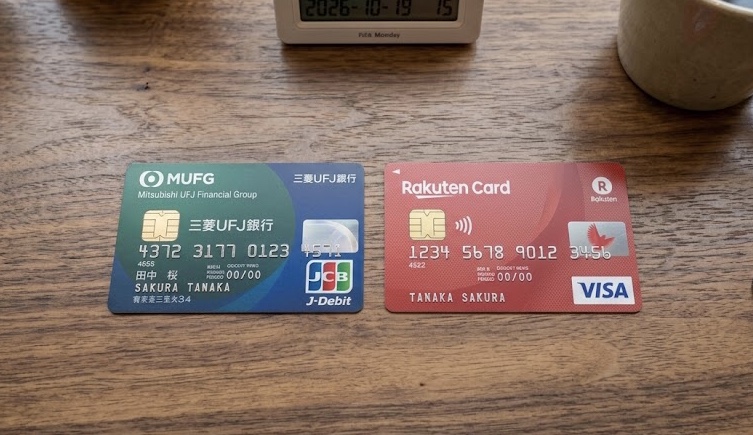
When you open a bank account in Japan, you will often receive a plastic card. It may look like a debit card, have an IC chip, or even display a Visa or JCB logo.
However, whether you can use it to pay at a convenience store or shop depends on the type of card you have.
The confusion comes from the different functions Japanese banks offer. A cash card (kyasshu kado) is primarily designed for ATM transactions. A debit card is designed for payments directly from your bank account. Some cards combine both functions, while certain cash cards also support Japan's domestic J-Debit payment system.
This guide explains the differences, what your card can actually do, and how to obtain the payment functionality you need.
What Is a Cash Card?
A conventional cash card is a card issued by your bank to access your account through ATMs.
Depending on your bank and account, you can generally use it to:
- Withdraw cash from ATMs.
- Deposit cash into your account.
- Check your account balance.
- Transfer money to other accounts at supported ATMs.
However, an ordinary ATM-only cash card cannot be used to make purchases at shops or pay for online orders.
There is an important exception: some Japanese cash cards support J-Debit, a domestic payment system that lets customers pay at participating merchants by using their bank cash card and entering their PIN.
J-Debit is different from Visa Debit and JCB Debit. Its acceptance is limited to participating merchants in Japan, and it does not provide the same international online-payment functionality as an international-brand debit card.
Ordinary cash cards generally do not require the creditworthiness assessment associated with credit cards. However, account-opening eligibility and card conditions vary by bank and account type.
What Is a Debit Card?
A debit card is a payment card linked directly to your bank account. When you use it to pay at a participating shop or online merchant, the money is generally deducted directly from your account.
Depending on the card, a debit card can be used for:
- In-store purchases at merchants accepting its payment network.
- Online shopping.
- Overseas purchases, where supported.
- Cash withdrawals at compatible ATMs, including some overseas ATMs.
Visa Debit and JCB Debit use their respective payment networks. Acceptance depends on the merchant, card issuer, and transaction type.
The main difference from a conventional credit card is when the money is taken from your account.
With a debit card, payments generally draw on the funds available in your bank account. With a credit card, purchases are charged to a credit account and billed later.
Debit-card transactions are usually processed promptly, but some transactions may be posted later or involve temporary authorizations and subsequent adjustments.
Why This Confuses Foreigners
In many countries, people receive a debit card when they open a bank account. That card works at ATMs and can also be used to pay at shops and online.
In Japan, a conventional cash card is primarily an ATM-access card, and payment functionality is not guaranteed.
However, the distinction is not absolute. Japanese banks offer several different arrangements:
- ATM-only cash card: Primarily used for ATM transactions.
- Cash card with J-Debit: Can also pay at participating domestic merchants.
- Combined cash card and international-brand debit card: Works at ATMs and supports payments through Visa, JCB, or another supported payment network.
If you want to pay directly from your bank account at shops and online, check whether your existing card supports the necessary payment function.
You may need to apply for a debit card separately or request a combined card.
A credit card is another option, but it requires a separate application and usually involves a credit assessment.
The Combined Cash Card and Debit Card Option
Many Japanese banks offer cards that combine ATM access with debit-payment functionality.
For example, Seven Bank offers a cash card with JCB debit functionality. Japan Post Bank also offers a combined cash-card-and-Visa-debit product.
AEON Bank offers debit-card products as well, although the precise features depend on the product you choose.
With a combined card, you can generally access your bank account through supported ATMs and pay at participating merchants using the card's debit network.
However, having a combined card does not guarantee that every merchant will accept it. Some transaction types may be restricted, and online payments may require additional authentication.
Do You Need a Separate PIN?
Not necessarily.
PIN arrangements depend on the bank and card. Some products use different PINs for different functions, while others have different arrangements.
Check your bank's instructions rather than assuming that your cash-card PIN will always work for debit purchases.
What Does the Logo on Your Card Mean?
A common mistake is to assume that every card displaying a familiar payment logo can be used for purchases.
The logo is an important clue, but you must identify the actual card product.
Visa or JCB
If your card displays a Visa or JCB payment logo, it may support purchases through that network. For example, a Visa debit card can generally be used at participating Visa merchants.
However, check your card's product name and documentation to confirm that it actually includes debit-payment functionality.
PLUS or Cirrus
PLUS and Cirrus are associated with ATM networks. Their logos can indicate compatibility with certain ATMs, including overseas ATMs.
These logos do not, by themselves, establish that a card supports Visa or JCB debit purchases.
How to Check Your Card
Look for terms such as:
- Debit (debitto).
- Visa Debit.
- JCB Debit.
- J-Debit.
You can also check the card's name in your banking app, review your bank's product information, or contact the bank directly.
Do not rely on the physical appearance of the card alone. A card's payment functionality depends on the product and services associated with it.
Debit Card Limitations in Japan
Even if you have a debit card, it will not necessarily work everywhere a credit card is accepted.
1. Installment and revolving payments
Debit cards generally do not offer conventional credit-card installment payments or revolving credit because transactions draw on your bank account rather than a credit line.
2. Insufficient funds
If your available balance is insufficient, a debit transaction will generally be declined.
Some transactions may also require additional available funds because the merchant places a temporary authorization on the account.
3. Limited merchant acceptance
Some merchants and services do not accept debit cards, even if they accept credit cards.
Depending on the card issuer and merchant, restrictions may apply to:
- Certain gas stations.
- Expressway toll payments.
- Recurring subscriptions.
- In-flight purchases.
- Certain hotel or rental-car transactions.
- Some online services.
Check the issuer's restrictions if you intend to use your card for a particular service.
4. ETC cards
A standard debit card generally cannot be used to obtain a conventional ETC card for Japanese expressway tolls.
ETC cards are usually issued through eligible credit-card or other ETC arrangements. Eligibility depends on the specific product and issuer.
If you drive in Japan and need ETC, check the available options separately rather than assuming your debit card will qualify.
5. Overseas transactions
Overseas ATM withdrawals and overseas purchases are different functions.
A card may support international ATM withdrawals without supporting international-brand purchases. Conversely, an international-brand debit card may support purchases but have restrictions on overseas cash withdrawals.
Check your bank's fees, withdrawal limits, foreign-currency conversion charges, and overseas-use settings before travelling.
How to Get a Debit Card in Japan
The application process depends on your bank and the type of card you want.
Option 1: Apply for a combined cash card and debit card
If your bank offers a combined card, check whether you can apply through its app, website, or a branch.
Eligibility conditions vary. Some products have minimum-age requirements, and the bank may require identity verification and other application checks.
A conventional debit card generally does not require the same creditworthiness assessment as a credit card, but the bank can still apply its own eligibility and verification procedures.
Option 2: Apply for a separate debit card
Some banks offer debit cards separately from their ordinary cash cards.
Check whether the debit card can be linked to your existing bank account and whether you need to submit a separate application.
Option 3: Apply for a credit card
If you want a credit card rather than a debit card, you must apply for a credit product.
Approval is not guaranteed. The issuer may consider factors such as income, employment, residence circumstances, and credit history.
Foreign residents may find that eligibility requirements differ between issuers, so check the specific conditions before applying.
The Bottom Line
Your Japanese bank card may be an ATM-only cash card, a cash card with J-Debit functionality, or a combined cash card and international-brand debit card.
These products can look similar, but their payment capabilities are different.
Remember these key points:
- Cash card: Primarily used to access your bank account through ATMs. An ordinary ATM-only cash card cannot make purchases.
- J-Debit: Allows eligible cash cards to pay at participating domestic merchants, but acceptance is limited.
- Visa Debit or JCB Debit: Allows payments through the relevant network at participating merchants, subject to card restrictions.
- Combined card: May provide both ATM access and debit-payment functionality.
- Payment logos: Visa and JCB logos can indicate payment functionality, while PLUS and Cirrus are associated with ATM access. Always confirm the actual card product.
- Debit-card limitations: Insufficient funds, merchant restrictions, foreign transaction fees, and the lack of conventional credit facilities can affect how you use the card.
If you want to pay directly from your Japanese bank account at convenience stores, restaurants, shops, and online merchants, first confirm what your current card supports. If it does not provide the payment functionality you need, ask your bank about applying for a debit card or a combined cash-card-and-debit product.
For personalized assistance with Japanese banking, tax, pension, or other administrative matters, contact HSB JAPAN for a professional consultation.