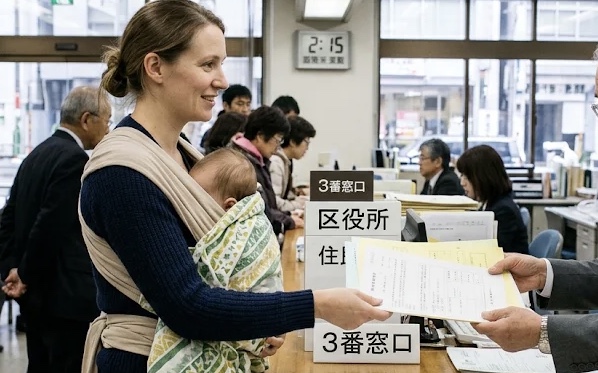
You have a child. You are registered as a resident of a Japanese municipality. You have filed the birth notification. And then you discover that the monthly payment you were expecting has not arrived, because nobody told you that the birth notification does not automatically trigger the Children's Allowance.
The Children's Allowance (jido teate) is a cash benefit paid to the person raising a child in Japan. It is separate from the Childbirth Lump-Sum Grant, separate from the Maternity Allowance, and separate from anything related to your pension. Foreign residents who meet the eligibility requirements can receive exactly the same allowance as Japanese nationals.
This article explains how much the allowance pays, who receives it, how to apply, and the deadline that determines whether you receive all the payments you are entitled to.
What the Allowance Pays
The amount depends on the child's age and their position among the children you are raising.
For a first or second child:
- Under 3 years old: ¥15,000 per month.
- From 3 years old until the end of high school age: ¥10,000 per month.
For a third child or later:
- Under 3 years old: ¥30,000 per month.
- From 3 years old until the end of high school age: ¥30,000 per month.
The allowance covers children until the first March 31 after they turn 18. This is commonly described as the high-school-age bracket, and it was extended from the previous junior-high-school cutoff as part of the October 2024 reform.
The income limit was abolished in the same reform. Previously, higher-income households received reduced amounts or nothing at all. Since October 2024, eligible households receive the full applicable amount regardless of income.
The Third-Child Counting Rule That Catches People
The third child is not necessarily your third child in age order. The calculation includes children counted from the oldest, including certain older children up to the first March 31 after they turn 22.
However, children aged 18 to 22 are not automatically included. The parent must continue providing care and supervision equivalent to parental responsibility and bear a substantial portion of their living expenses.
For example, suppose you have:
- A 20-year-old university student whom you financially support.
- A 15-year-old child.
- A 5-year-old child.
If the 20-year-old meets the care and financial-support requirements, the 15-year-old counts as the second child and the 5-year-old counts as the third child. The 5-year-old therefore qualifies for ¥30,000 per month.
To have an older child counted, you must submit a confirmation document called Kango Soto, Seikeihi no Futan ni Tsuite no Kakuninsho to your municipality.
If you do not submit this document when required, the older child may not be included in the calculation, meaning your younger children could receive a lower allowance than they would otherwise qualify for.
Importantly, an older child can still qualify even if they are employed, provided the required care and financial-support conditions are met.
Who Receives It
The allowance is generally paid to the parent who maintains the household financially to the greater extent. In most cases, this means the parent with the higher income, not automatically the mother.
When both parents work, the municipality determines the recipient based primarily on their income and overall household circumstances. Other considerations, such as tax dependency and health insurance arrangements, may also be relevant.
There is an important exception when parents are living separately because of divorce proceedings. In such circumstances, the allowance is generally paid to the parent living with the child rather than automatically to the higher-income parent.
Foreign residents are eligible under the same general rules as Japanese nationals, provided they satisfy the residence and other eligibility requirements.
Generally, the applicant must be registered in the Basic Resident Register (jumin kihon daicho), and the child must also meet the applicable residence requirements.
Foreign nationals without an eligible status of residence and those with a period of stay of three months or less are generally excluded.
Children living outside Japan are also generally excluded, except in specific circumstances involving study abroad.
Having a residence card alone does not automatically establish eligibility. The municipality checks the applicant's and child's circumstances when processing the application.
When and How It Is Paid
The Children's Allowance is paid six times a year, in February, April, June, August, October, and December.
Each payment covers the two preceding months.
For example:
- February payment: December and January.
- April payment: February and March.
- June payment: April and May.
- August payment: June and July.
- October payment: August and September.
- December payment: October and November.
The exact bank transfer date is determined by your municipality. Many municipalities use the 10th of the payment month, moving the date forward if it falls on a weekend or public holiday, but this is not a nationwide fixed date.
Check your municipality's published payment schedule for the exact date.
The money is transferred to a bank account in the recipient's name. An account in the spouse's name or the child's name generally cannot be used.
The Deadline That Determines Your Money
This is the part that matters most, and the part that catches foreign parents who assume the birth notification is enough.
You must submit the Children's Allowance application (Nintei Seikyusho) within 15 days, counting from the day after the birth.
If you apply within this period, the allowance normally begins from the month following the birth.
If you miss the deadline, the allowance generally starts from the month following your application, and you cannot recover the missed months retroactively.
There is an important exception for births and moves that occur near the end of a month. If you submit your application during the following month but within 15 days of the relevant event, you can still qualify for payment from the application month.
For example, if your child is born on November 1, your 15-day application period runs from November 2 through November 16.
If you apply on November 20, you have missed the deadline. The allowance will normally start in December, which is also the normal starting month for a November birth. In this particular example, you have not lost a payment month.
However, if you wait until January to apply, the allowance will normally start in February. You will lose the payments for December and January.
The same 15-day rule applies when you move to a new municipality. You must submit a new application to your new municipality rather than assuming your existing allowance will automatically transfer.
It also applies when you have another child and need to submit a notification or application to reflect the change in the number of children eligible for the allowance.
Do not assume that filing a birth notification or moving-out notification automatically completes the Children's Allowance procedure.
What You Need to Apply
The exact documents vary by municipality and your individual circumstances, but the standard application generally requires:
- The Children's Allowance application form (Nintei Seikyusho), available at your municipal office or on its website.
- My Number documentation for the applicant and spouse.
- Identification for the applicant.
- A bank passbook or cash card showing an account in the applicant's name.
Your municipality may also request additional documentation depending on your circumstances, such as:
- Residence information for the applicant, spouse, or children.
- Documentation concerning children living separately from the applicant.
- The confirmation form for older children aged 18 to 22 who are included in the third-child calculation.
- Additional documents needed to establish eligibility for foreign residents.
Some municipalities may be able to verify information through government administrative systems without requiring you to submit separate certificates.
If you are unsure which documents are required, check with your municipal office before submitting the application.
What Happens If You Leave Japan
The Children's Allowance is tied to the recipient's eligibility under the Japanese resident registration and benefit system.
If you leave Japan permanently and your eligibility ends, the payments stop. You must submit a notification of loss of eligibility (Jukyu Jiyu Shometsu Todoke) to your municipal office.
This should be completed as part of your departure procedures. Do not assume that filing your overseas moving-out notification automatically completes every Children's Allowance requirement.
If your child leaves Japan for study abroad, the allowance may continue under specific circumstances.
Generally, the following conditions must be satisfied:
- The child must have continuously lived in Japan for more than three years immediately before moving abroad.
- The child must be leaving Japan for educational purposes.
- The period abroad must be within three years from the date the child stopped residing in Japan.
- The child must not be living overseas together with their parents.
You must submit the appropriate study-abroad notification and supporting documentation to your municipality. The authorities will determine whether the conditions are satisfied.
The general rule remains that children living outside Japan are not eligible for the Children's Allowance unless they qualify for one of the specific exceptions.
The Bottom Line
The Children's Allowance is a monthly payment available to foreign residents raising eligible children in Japan. The amount depends on the child's age and their position in the family, with the third-child rate applying more broadly than many parents expect.
The October 2024 reform made significant improvements to the system:
- Income restrictions were abolished.
- Eligibility was extended through high-school age.
- The third-child allowance increased to ¥30,000 per month.
- Certain children aged 18 to 22 can now be included when calculating the third-child payment, provided the required care and financial-support conditions are met.
Most importantly, the birth notification does not automatically trigger the payment. You must submit a separate Children's Allowance application within 15 days of the day after the birth to avoid losing payments.
If you move to another municipality or have another child, remember that additional notifications or applications may also be required.
For assistance with Japanese maternity benefits, municipal procedures, or understanding which allowances apply to your family, contact HSB JAPAN for a professional consultation.