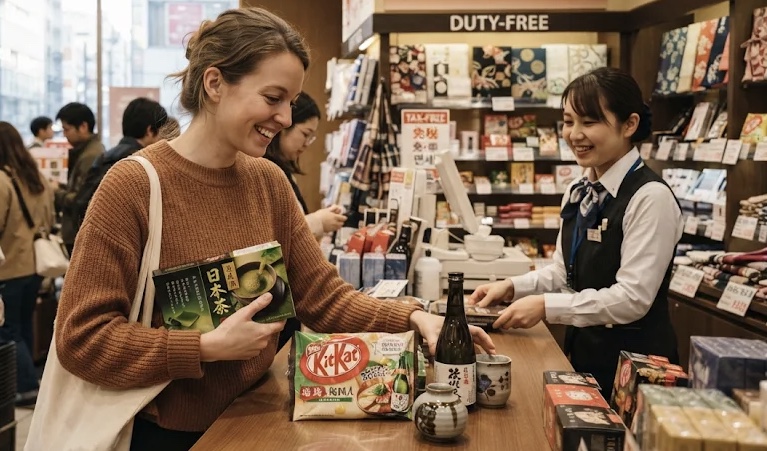
If you have visited Japan before, you probably remember how tax-free shopping worked: show your passport at a participating store, have the consumption tax removed at the checkout, and leave with your purchases.
That system changed on November 1, 2026.
Japan has introduced a refund-based system. Instead of receiving the tax exemption immediately at the shop, eligible visitors now pay the full, tax-inclusive price and claim their consumption tax refund after customs confirms that the purchased goods are being taken out of Japan.
The change affects how you shop, how you pack your purchases, and what you need to do at the airport before departure.
Here is what you need to know.
First, Who Is Eligible for Tax-Free Shopping?
The new refund system does not mean that everyone shopping in Japan can claim a consumption tax refund.
Tax-free shopping is generally available to eligible non-residents, including foreign visitors entering Japan under the Temporary Visitor status. Certain diplomats and officials may also qualify. Japanese nationals living abroad can qualify under specific conditions.
Foreign nationals who live in Japan under ordinary residence statuses, such as work or student visas, generally cannot use the tourist tax-free shopping system.
You must also meet the applicable identification and purchase requirements. Present your passport or other accepted documentation when making a qualifying purchase.
1. You Pay the Full Price at the Store
The most important change is that stores no longer remove consumption tax at the checkout under the new system.
From November 1, 2026, you pay the full price, including Japan's consumption tax.
For example, if an item costs ¥11,000 including 10% consumption tax, you pay ¥11,000 at the store. You then claim the eligible tax refund after customs confirms that the goods are being taken out of Japan.
The store or its designated refund operator handles the refund. Customs does not hand you the money directly.
The refund method depends on the shop. It may be issued to a credit card, through a bank transfer or payment application, or in cash at a designated location. Some shops may require you to register your preferred refund method when you make the purchase.
Important: Ask the shop how its refund procedure works before paying. Do not assume every store uses the same method or that the refund will automatically be credited to the card you used.
2. The ¥5,000 Minimum Purchase Requirement Still Applies
The minimum purchase requirement has not disappeared.
To qualify, you generally need to spend at least ¥5,000, excluding consumption tax, at the same tax-free shop on the same day.
Purchases from different shops cannot be combined to reach the minimum.
For example:
- ¥3,000 at Store A and ¥2,500 at Store B do not qualify together.
- ¥5,000 or more before tax at Store A on the same day meets the minimum.
The purchase must also meet the other tax-free eligibility requirements.
3. You Have 90 Days to Complete the Customs Procedure
You cannot wait indefinitely to claim your refund.
The goods must be taken out of Japan, and the customs confirmation procedure must be completed within 90 days of the purchase date.
The 90-day period is counted from the day after the purchase.
For example, if you buy something on November 1, 2026, the customs procedure must be completed by January 30, 2027.
You must complete the procedure before departing Japan. It is not something you can do after returning home.
4. What Happens at the Airport? The Green and Red Results
Before leaving Japan, you must complete the customs confirmation procedure.
At participating airports, you can use a tax-free purchase confirmation terminal or the relevant electronic procedure.
You will generally need your passport and the information associated with your tax-free purchases. Customs may also ask to inspect the actual goods.
The terminal can display one of two results:
Green result:
Your customs confirmation is complete, and no additional inspection is required.
Red result:
You must present your purchases to a customs officer for inspection.
Do not ignore a red result or proceed as if your purchases have already been cleared. Follow the instructions and present the goods to customs.
Can You Use Visit Japan Web?
Yes. The tax-free purchase confirmation procedure is also available through Visit Japan Web at participating airports.
As of November 2026, the service is available at:
- Narita International Airport
- Haneda Airport
- Kansai International Airport
- Chubu Centrair International Airport
- Fukuoka Airport
- New Chitose Airport
- Naha Airport
If you intend to use this option, set up Visit Japan Web before arriving at the airport. Dedicated Wi-Fi is available in the departure areas at the participating airports.
Availability and the exact procedure can depend on the airport, so check the latest instructions before travelling.
5. All Items from the Same Purchase Must Be Available for Inspection
This is one of the most important practical details of the new system.
All goods included in a single tax-free purchase record must be available when customs checks that purchase.
In other words, if your receipt covers five items, you cannot expect to receive a refund for four of them while leaving the fifth item behind.
If even one item from that purchase record is missing, customs cannot confirm the tax-free export of the items covered by that record.
This does not mean that purchases from different receipts must all be packed together. The requirement applies to the goods included in each individual purchase record.
Keep your purchases accessible until the customs procedure is complete.
6. Do Not Put Your Purchases in Checked Luggage Too Early
This is particularly important if you are travelling with large or heavy purchases.
The customs confirmation procedure must be completed before you check in your baggage.
If you put your purchases in a suitcase and hand it over to the airline before customs has confirmed them, you may no longer be able to present the goods for inspection.
This can become a serious problem if the terminal displays a red result and customs needs to examine your purchases.
The safest procedure is:
- Keep all tax-free purchases accessible.
- Go through the customs confirmation procedure before checking in your baggage.
- If customs requests an inspection, present the relevant goods.
- Once the procedure is complete, proceed with baggage check-in.
If you have large purchases that you intend to put in checked luggage, plan accordingly. Do not assume that showing a receipt or photograph will replace presenting the actual goods.
7. The Old Consumables Rules and Special Packaging Have Disappeared
Under the previous system, Japan treated general goods and consumables differently.
Consumables included items such as food, beverages, cosmetics, and medicines. They were subject to special packaging requirements and a ¥500,000 purchase limit. General goods were treated differently.
Those distinctions have been abolished under the new system.
The separate consumables packaging requirement and the ¥500,000 consumables purchase limit no longer apply. The requirement that purchases be divided into general goods and consumables has also been removed.
However, this does not mean you can consume your purchases in Japan and still claim a refund.
If you consume consumables such as food, beverages, or cosmetics in Japan, those goods cannot qualify for the export confirmation required for the refund.
If you have consumed any such goods, do not simply proceed through the confirmation terminal as though all the goods were still available. Follow the instructions from customs and report the situation to a customs officer. Consumed goods cannot receive the tax refund.
The important distinction is that the old special packaging rules have disappeared, but the requirement to take eligible goods out of Japan remains.
8. What About Items Shipped Separately?
The rules concerning separately shipped purchases also need some explanation.
Under the old system, a shopper could arrange to send tax-free purchases out of Japan separately as unaccompanied baggage, subject to specific requirements.
That purchaser-arranged separate-shipment procedure was abolished on March 31, 2025.
However, this does not mean that every form of direct shipping has become impossible.
A retailer may still arrange to ship goods directly overseas under a separate export-exemption procedure. This is a different arrangement from a shopper buying goods tax-free and independently sending them abroad.
If you want a store to ship your purchases overseas, ask whether it offers this service and how the export procedure is handled. Do not assume that ordinary international shipping automatically qualifies for a tax exemption or refund.
9. What You Should Do Before Leaving Japan
The new system is not especially complicated once you understand the order of the steps. The main thing is to avoid packing, consuming, or losing access to your purchases before customs has confirmed them.
Here is a practical checklist:
- Check your eligibility: Make sure your immigration status and documentation qualify for tax-free shopping.
- Check the purchase amount: Spend at least ¥5,000 before tax at the same participating store on the same day.
- Ask about the refund method: Find out how the shop will return the tax and whether you need to register any payment details.
- Keep your purchases: Make sure every item from each tax-free purchase record is available for customs inspection.
- Do not consume consumables: Food, drinks, cosmetics, and other consumables must be taken out of Japan to qualify.
- Prepare Visit Japan Web if you intend to use it: Check whether your departure airport supports the electronic procedure.
- Complete customs confirmation before baggage check-in: Keep your purchases accessible until customs has finished.
- Allow time for inspection: A red result may require you to visit a customs officer.
The Bottom Line
Japan's tax-free shopping system changed on November 1, 2026. Eligible shoppers now pay the full price at participating stores and receive their consumption tax refund after customs confirms that the goods are being taken out of Japan.
The ¥5,000 minimum purchase requirement remains, and the customs procedure must be completed within 90 days of the purchase date.
The biggest practical change is the order of the process: you pay first, keep your purchases available, complete customs confirmation before checking in your baggage, and then receive the refund through the method arranged by the store.
If you remember one thing, make it this: do not put your tax-free purchases in checked luggage or consume them before customs has completed the required confirmation.
For assistance with Japanese tax refund procedures, consumption tax documentation, or understanding which rules apply to your purchases, contact HSB JAPAN for a professional consultation.