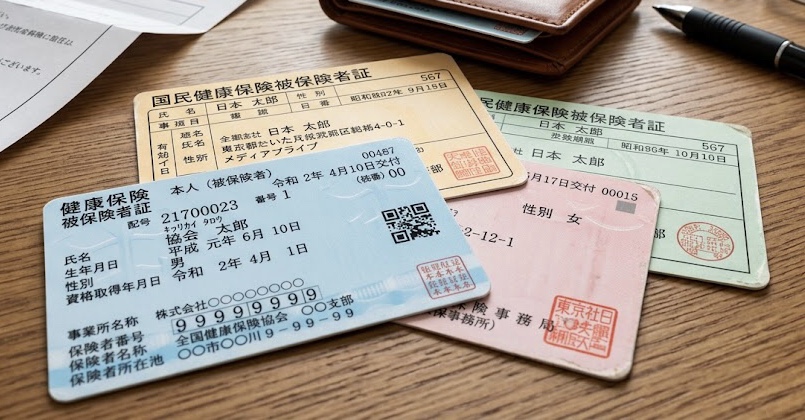
If you live in Japan and are required to participate in the public health insurance system, you generally cannot simply opt out because of your nationality or visa status.
For foreign workers, the two systems you will most commonly encounter are Employee Health Insurance (Kenko Hoken), which is part of the employee social insurance system, and National Health Insurance (Kokumin Kenko Hoken).
Which system applies to you depends mainly on your employment situation and whether you meet the legal requirements for employee insurance.
The financial difference between the systems can be significant, particularly for households with several family members.
The Core Difference: How Premiums Are Calculated
Employee Health Insurance
For employees, the health-insurance premium is generally calculated using your Standard Monthly Remuneration (Hyojun Hoshu Getsugaku), which is based on your regular remuneration.
For ordinary health-insurance premiums:
- Your employer generally pays half of the premium.
- You pay the other half through payroll deductions.
- A qualifying spouse or child can generally be covered as a dependent without an additional health-insurance premium.
- The employee's own premium is therefore generally not increased simply because additional qualifying dependents are added.
For 2026, the average health-insurance rate for employees covered by Kyokai Kenpo is 9.90%, although the actual rate varies by prefecture. For example, the 2026 rates range from 9.21% in Niigata to 10.55% in Saga.
The 9.90% figure is the total ordinary health-insurance rate before the employer/employee split. It is therefore not the percentage that is simply deducted from the employee's salary.
There are also other social-insurance contributions and deductions, including the Employees' Pension Insurance premium and the separate 2026 Child and Childcare Support Contribution. These should not be confused with the ordinary health-insurance premium.
National Health Insurance
National Health Insurance (NHI) is generally used by people who are not covered by another public health-insurance system, including many self-employed people, freelancers, unemployed residents, and employees who do not qualify for Employee Health Insurance.
NHI premiums are determined by the municipality and generally use a combination of:
- Income-based portion (Shotoku-wari): based on the applicable assessment income from the previous year
- Per-person portion (Kinto-wari): a fixed amount for each insured person
- Per-household portion (Byodo-wari): a fixed amount per household, where applicable
The exact calculation differs between municipalities.
Unlike Employee Health Insurance, NHI does not have the same dependent system. Each person who is insured under NHI is included in the household's premium calculation.
You also pay the NHI premium yourself because there is no employer paying half of it.
Example: Kobe's 2026 NHI Rates
To show how municipal NHI calculations work, Kobe City's 2026 rates include:
- Medical portion: assessment-base income × 7.38% + ¥33,700 per insured person + ¥21,800 per household
- Support portion: assessment-base income × 2.97% + ¥13,510 per insured person + ¥8,740 per household
- Child and childcare support portion: assessment-base income × 0.26% + ¥1,330 per applicable insured person + ¥830 per household
The assessment-base income is not simply your gross salary; it is calculated under the municipality's NHI rules.
People aged 40–64 can also be subject to the separate long-term-care insurance portion.
These are only Kobe's 2026 rates. Your actual NHI premium can be very different if you live in another municipality.
Always check your local city, ward, or town office for the current calculation.
The "Second-Year Shock" with National Health Insurance
One of the biggest surprises for foreign workers is how NHI responds to previous-year income.
When you first arrive in Japan, your municipality may have little or no previous-year Japanese income to use when calculating your income-based NHI premium. As a result, your initial premium can be relatively low.
After you have earned income in Japan, that previous-year income can be reflected in the following year's NHI calculation.
For example:
- Year 1: You arrive in Japan and have little or no previous-year income recorded for the NHI calculation.
- Year 2: Your previous year's income is now reflected in the calculation, potentially increasing your NHI premium.
- If you lose your job: Your NHI premium can still reflect your previous year's income even though your current income has fallen.
This is one reason someone who becomes unemployed can find their NHI bill unexpectedly high.
However, municipalities have reduction systems, and certain people who lose employment involuntarily may qualify for specific reductions. If your income falls, contact your municipality rather than simply stopping payment.
What You Actually Get: Medical Coverage
Both systems provide public health-insurance coverage for medically necessary treatment within the Japanese insurance system.
For most working-age adults, the standard patient copayment for covered medical treatment is 30%, with the insurance covering the remaining 70%.
Both systems generally cover things such as:
- Doctor visits
- Hospital treatment
- Surgery
- Covered prescription medication
- Other medical treatment covered by public health insurance
However, the benefits are not completely identical.
One important difference is that Employee Health Insurance provides certain cash benefits that are generally not available through National Health Insurance in the same way.
For example, eligible employees covered by Employee Health Insurance may receive:
- Maternity Allowance (Shussan Teatekin) when they stop working because of childbirth
- Injury and Sickness Allowance (Shobyo Teatekin) when qualifying employees cannot work because of illness or injury
These benefits are separate from ordinary medical treatment coverage.
Therefore, the difference between the two systems is not purely the amount of the premium. The systems also differ in their family coverage and certain cash benefits.
The Family Cost Difference
This is where Employee Health Insurance can make a major difference for families.
Scenario: Employee With a Spouse and Two Children
Suppose one employee has a spouse and two children who all qualify as dependents.
Employee Health Insurance
- The employee's premium is based primarily on the employee's applicable remuneration.
- The spouse and children can generally be covered as dependents without separate health-insurance premiums.
- The employer generally pays half of the ordinary health-insurance premium.
The employee therefore does not pay an additional health-insurance premium simply because three qualifying dependents are covered.
National Health Insurance
- The household's NHI premium is calculated under the municipality's rules.
- Each insured family member is generally included in the calculation.
- Per-person charges can therefore increase as additional family members are insured.
- There is no employer paying half of the NHI premium.
As a result, NHI can be substantially more expensive for some families than Employee Health Insurance.
However, there is no universal rule that NHI costs two or three times more. The actual difference depends on income, municipality, household size, ages, applicable reductions, and whether family members qualify as dependents under Employee Health Insurance.
When Do You Qualify for Employee Health Insurance?
Whether you must join Employee Health Insurance depends on your employer and your working conditions.
For employees of covered workplaces, one major test is whether you work at least three-quarters of the normal working hours and working days of a regular employee in the same workplace.
Shorter-hours employees can also be covered when additional statutory conditions are satisfied. These can include requirements relating to:
- Working at least 20 hours per week
- Monthly wages meeting the applicable threshold
- An expected employment period of more than two months
- Not falling under the applicable student exclusion
- Working for an employer subject to the relevant short-hours employee insurance rules
The employer-size requirement for short-hours workers has changed over time and is scheduled to be expanded further.
Being a foreign worker does not by itself exempt you from Employee Health Insurance.
If you are unsure which system applies to you, ask your employer or the relevant health-insurance organization.
What Happens If You Lose Your Job?
If you leave a job and your Employee Health Insurance coverage ends, you generally need to arrange other public health-insurance coverage.
Depending on your circumstances, the main options can include:
1. Voluntary Continuation of Employee Health Insurance
Some people can continue their previous Employee Health Insurance voluntarily for up to two years.
With voluntary continuation, you generally pay the entire premium yourself because your former employer no longer pays its share.
For Kyokai Kenpo, the application generally must reach the insurer within 20 days after the loss of coverage, and other eligibility requirements apply.
Because you are paying the full premium, voluntary continuation is not automatically cheaper than NHI. However, depending on your previous remuneration, household circumstances, municipality, and dependents, it can sometimes be financially advantageous.
2. Switch to National Health Insurance
If you are no longer covered by Employee Health Insurance or another public health-insurance system, you may need to enroll in NHI through your municipality.
The notification is generally required within 14 days of becoming eligible.
Do not assume that waiting to enroll will eliminate the premiums. NHI coverage and premiums can be applied retroactively to the date you became eligible.
Your NHI premium may also continue to reflect your previous year's income.
3. Become a Dependent of a Family Member
If your spouse or another qualifying family member is covered by Employee Health Insurance, you may be able to become their dependent if you satisfy the insurer's requirements.
A commonly used income guideline is ¥1.3 million per year, but the actual rules contain exceptions and additional conditions.
The dependent's income is not the only factor. The relationship, financial support, employment situation, and the specific insurer's rules can also matter.
Employee Health Insurance vs. National Health Insurance
| Employee Health Insurance | National Health Insurance | |
|---|---|---|
| Who generally uses it | Employees who meet coverage requirements | Residents not covered by another public health-insurance system |
| Premium basis | Standard Monthly Remuneration and applicable remuneration rules | Municipality's NHI calculation, generally including previous-year income |
| Employer contribution | Generally pays half of ordinary health-insurance premium | None |
| Dependents | Qualifying dependents generally have no separate health-insurance premium | Each insured person is included in the premium calculation |
| Medical copayment | Generally 30% for working-age adults | Generally 30% for working-age adults |
| Maternity Allowance | Available to eligible insured employees | Generally not available in the same employee-insurance form |
| Injury and Sickness Allowance | Available to eligible insured employees | Generally not available in the same employee-insurance form |
| Rates | Vary by insurer; Kyokai Kenpo 2026 average health-insurance rate is 9.90% | Varies by municipality |
| Family cost | Qualifying dependents generally do not increase the health-insurance premium | Additional insured family members can increase the premium |
What Should You Do If Your NHI Premium Is Too High?
If your income has fallen, you have become unemployed, or your household circumstances have changed, contact your municipal NHI office.
Depending on your circumstances, you may qualify for:
- Income-based premium reductions
- Reductions for certain types of unemployment
- Other municipal relief programs
- Payment arrangements
Do not simply stop paying your NHI premiums.
Unpaid premiums can result in collection measures, and failing to meet public obligations can also create administrative or immigration issues in some circumstances.
If you are having difficulty paying, contact your municipality as soon as possible and ask what reduction or payment options are available.
The Bottom Line
Employee Health Insurance and National Health Insurance both provide Japan's public medical insurance coverage, but they are structured very differently.
With Employee Health Insurance, the employer generally pays half of the ordinary premium, and qualifying dependents can generally be covered without separate health-insurance premiums. Eligible employees can also receive certain cash benefits such as Maternity Allowance and Injury and Sickness Allowance.
With National Health Insurance, there is no employer contribution, and each insured family member is generally included in the municipal premium calculation. Your previous year's income can also have a major effect on the amount you pay.
The right system is therefore determined primarily by your employment and insurance circumstances, not simply by which system appears cheaper at first glance.
If you are on National Health Insurance and your income drops, contact your municipal office promptly to check whether you qualify for a reduction or other assistance.
For personalized assistance with Japanese tax procedures, resident tax, pension matters, or other administrative procedures, contact HSB JAPAN for a professional consultation.