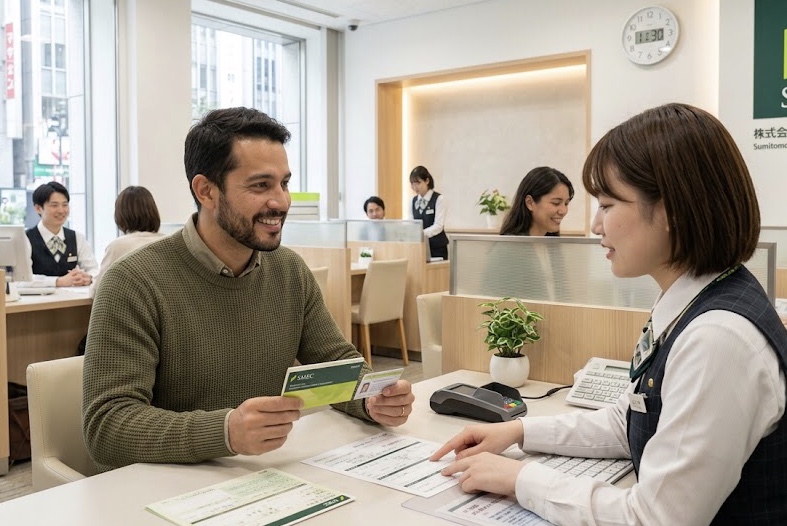
Opening a bank account in Japan is an important step for managing everyday life, receiving salary payments, paying rent and utilities, and handling other financial matters.
For foreign residents, opening an account is generally possible, but there is no single set of requirements that applies to every bank. Eligibility, required documents, application methods, and restrictions can vary significantly between banks and according to your residence status, length of stay, employment situation, and the type of account you want.
This guide explains the main requirements and restrictions foreign residents should know about in 2026.
1. The Essential Documents
The most important document for most foreign residents is a valid Residence Card (Zairyu Card). Special Permanent Residents generally use their Special Permanent Resident Certificate.
Banks use these documents to verify your identity, address, residence status, and period of stay. The exact documents required vary by bank and application method.
You may also be asked for:
- Passport: Some banks request it as additional identification or to confirm your entry into Japan.
- My Number Card: Some banks and procedures accept or request it as identification, but it is not a universal requirement for opening a bank account.
- My Number documentation: Depending on the bank and procedure, you may be asked for documentation relating to your My Number.
- Juminhyo (Residence Certificate): Some banks may request a residence certificate.
- Proof of employment: Particularly important if you have been in Japan for less than six months and the bank allows account opening based on employment.
- Other supporting documents: Requirements can include documents relating to your residence status, address, occupation, intended use of the account, or source of funds.
Your information should be consistent across your documents. If your address, name, residence status, or period of stay has changed, the bank may require updated documentation.
The Financial Services Agency (FSA) specifically advises foreign residents to keep their financial institutions informed when their residence period is renewed or while an extension application is pending.
Important: Do not assume that having a Residence Card automatically guarantees that a particular bank will approve your application. Each bank performs its own eligibility and screening procedures.
2. The "Six-Month Rule" — What It Really Means
One of the biggest sources of confusion for foreigners is the so-called six-month rule.
There is not a universal Japanese law saying that every foreigner must live in Japan for six months before opening a bank account.
Instead, individual banks can impose their own requirements, and the distinction between residents and non-residents under Japan's foreign-exchange regulations can also affect the type of account and services available.
For example, Tokyo Star Bank currently states that applicants can qualify for its Star One account if they:
- have been employed at an office in Japan, excluding part-time workers; or
- have resided in Japan for at least six months.
The bank also requires the appropriate residence documentation.
This means a newly arrived foreign worker may be able to open an account at some banks before completing six months in Japan, particularly where the bank recognizes Japanese employment as an eligibility route.
Why Banks Ask About Your Employment
If you have recently arrived in Japan, a bank may ask for evidence that you work in Japan, such as:
- Employment documentation
- Employer information
- Salary information
- Other documents specified by the bank
This is one reason it is useful to have your employment documents available when opening an account shortly after arriving.
Bottom line: The six-month requirement is bank-specific, not a blanket rule applying to every bank in Japan.
3. CRS: The Tax-Residence Self-Certification
When opening certain financial accounts in Japan, you may be required to submit a CRS self-certification concerning your tax residence.
CRS stands for the Common Reporting Standard, an international framework designed to facilitate the automatic exchange of financial-account information between tax authorities.
Japan has required self-certification for new financial accounts with reporting financial institutions since January 1, 2017.
The information can include:
- Your name
- Date of birth
- Address
- Jurisdiction(s) of tax residence
- Foreign Tax Identification Number (TIN), where applicable
Your tax residence is not necessarily determined simply by your nationality. It is determined according to the applicable tax rules.
For example, a foreign national living and working in Japan will generally need to consider Japan as a tax-residence jurisdiction if the relevant Japanese tax-residence conditions are met.
If you have tax residence in more than one jurisdiction, you may need to declare all applicable jurisdictions.
What Happens If Your Tax Residence Changes?
If the information in your CRS self-certification changes, you generally must submit a Self-Certification for Changes in Circumstances within three months of the relevant change.
What's New in 2026?
There is an important 2026 CRS change, but it should not be confused with the introduction of CRS self-certification.
Self-certification itself has existed since 2017.
From January 1, 2026, the Japanese CRS reporting framework was expanded to include certain electronic payment instruments and digital-money products within the scope of reportable financial accounts.
Therefore, the accurate statement is:
CRS self-certification is not new in 2026. However, the scope of Japan's CRS reporting framework was expanded in 2026 to cover certain additional electronic payment instruments.
4. Online vs. In-Person Account Opening
Many Japanese banks now offer online or app-based account opening, but foreign residents should not assume that every bank or every residence status can use the online procedure.
Depending on the bank, online identification may involve:
- Scanning the IC chip on your Residence Card
- Photographing the card
- Taking a selfie
- Facial verification
- Entering information from the Residence Card
- Providing additional documentation electronically
Other applicants may have to apply by mail or visit a branch.
Residence Status Can Affect Online Applications
Tokyo Star Bank, for example, currently states that certain customers cannot open an account online, including people with certain residence statuses. For Residence Cards issued on or after June 14, 2026, it specifically lists Cultural Activities, Student, Trainee, and Dependent (Family Stay) among statuses that cannot use its online account-opening process.
This does not mean those people are universally prohibited from having bank accounts. It means that the bank's particular online application route is restricted.
The appropriate branch or alternative application method may still be available, subject to the bank's rules.
5. The 2026 Residence Card Change
There is a genuine 2026 issue involving newly issued Residence Cards.
Residence Cards issued from June 14, 2026 use a new format, and banks have had to update their systems to recognize them.
This has temporarily affected some banking apps.
Japan Post Bank Example
Japan Post Bank announced that Residence Cards issued on or after June 14, 2026 initially could not be used for identity verification in its apps.
However, this situation is changing.
Japan Post Bank states that on August 27, 2026, it will release an updated version of its account-procedure app supporting Residence Cards issued from June 14, 2026, except for Specified Residence Cards.
Specified Residence Cards—which combine Residence Card and My Number Card functions—remain unsupported in that app for the time being, according to Japan Post Bank. Customers using those cards are directed to a Japan Post Bank or post-office savings counter.
Because today's date is August 24, 2026, this is particularly important:
If you have a Residence Card issued on or after June 14, 2026, check the bank's current application requirements before attempting an app-based application. The situation is changing as banks update their systems.
Do not assume that an app's current inability to read your card means you are ineligible for a bank account.
6. Visa Status and Non-Resident Accounts
Your nationality alone does not determine whether you can use Japanese banking services.
The important distinction is between being a resident of Japan for banking/foreign-exchange purposes and being a non-resident, together with the bank's own account policies.
Foreign residents with appropriate residence documentation can generally apply for resident bank accounts, subject to the bank's requirements and screening.
What About People Who Have Been in Japan Less Than Six Months?
A person who has recently arrived may still be able to open an account, depending on the bank.
For example, Tokyo Star Bank expressly lists employment at a Japanese office as an eligibility route in addition to six months of residence.
What About Non-Residents?
It is incorrect to say that non-residents are universally prohibited from having Japanese bank accounts.
Some banks offer specific products or arrangements for non-residents, while other banks may restrict or refuse account opening for people who are no longer resident in Japan.
Therefore, if you are leaving Japan, do not simply assume that you can continue using your existing account normally as a non-resident. Ask your bank what happens to the account and what services remain available.
The FSA specifically provides guidance to foreign residents concerning banking services and emphasizes the importance of properly handling accounts when leaving Japan.
7. Keeping Your Bank Account Active After Opening It
Opening the account is only the beginning.
Foreign residents should keep their bank informed of changes to:
- Residence Card information
- Residence period
- Address
- Name
- Tax-residence information
- Other information requested by the bank
Residence Card Renewal
If your period of stay is extended, tell your bank and provide the updated information when required.
The FSA, National Police Agency, and Immigration Services Agency have specifically warned foreign residents about keeping financial institutions informed of residence-period extensions and applications.
Failing to update your information can eventually result in restrictions on transactions.
Do not wait until your bank account stops working before updating your residence information.
8. Hanko: Do You Need a Personal Seal?
Not necessarily.
Many modern bank-account opening procedures can be completed using electronic identification and/or a signature rather than requiring a traditional personal seal.
However, requirements vary by bank and by the particular service.
If you are opening an account through an app, a hanko will generally not be part of the electronic identification process.
For branch applications, ask the bank whether a seal is required before visiting.
9. Cash Card vs. Debit Card
Do not assume that every Japanese bank card works like a Western debit card.
A traditional cash card is primarily used for:
- ATM withdrawals
- Deposits
- Balance inquiries
- Other banking-machine transactions
A debit card may provide additional functionality, such as paying directly from your bank account for purchases.
Some Japanese banks issue or offer debit functionality with their cards, while others require you to apply for a separate debit-card product.
Therefore, if you specifically want a card for online shopping or overseas purchases, ask for a debit-card product rather than assuming a standard cash card will provide that functionality.
10. Bankbooks and Banking Fees
Whether you receive a traditional paper bankbook depends on the bank and account.
Some banks increasingly encourage digital statements and may charge fees for issuing or maintaining certain types of physical bankbooks.
For example, some Mizuho products can involve a fee for requesting a physical passbook.
Before opening an account, check:
- Whether a physical bankbook is issued
- Whether there is a passbook fee
- ATM withdrawal fees
- Transfer fees
- Monthly account fees, if applicable
- Debit-card fees
- Overseas-remittance fees
These costs can differ substantially between banks.
11. Japanese-Language Support
Japanese remains the primary language of many Japanese bank branches.
However, some banks provide:
- English-language websites
- English application instructions
- Multilingual customer support
- English-language apps
- Multilingual documents
Japan Post Bank, for example, provides multilingual information and has developed application procedures specifically for foreign customers.
If your Japanese is limited, check the bank's available language support before visiting the branch.
12. What You Should Bring When Opening an Account
For a typical foreign resident, a practical checklist is:
Essential
- Valid Residence Card or Special Permanent Resident Certificate
- Japanese address
- Japanese telephone number, where required
- Basic personal information
Potentially Required
- Passport
- My Number documentation
- Juminhyo
- Employment documents
- Salary information
- Additional identification
- Information about the intended purpose of the account
- Tax-residence information/TIN for CRS purposes
The exact list depends on the bank and application method.
Do not assume that having every document on this list guarantees approval.
13. Step-by-Step: Opening Your First Bank Account
Step 1 — Choose the Bank
Compare banks based on:
- Eligibility for your residence status
- Six-month/employment requirements
- Online vs. branch application
- English-language support
- ATM network
- Fees
- International-remittance services
- Debit-card availability
Step 2 — Check Your Residence Card
Make sure:
- It is valid
- Your address is current
- Your name is correct
- Your residence status is current
- Your period of stay has not expired
Step 3 — Check the Application Method
Determine whether you can apply:
- Through a smartphone app
- Online
- By mail
- At a branch
Do this before visiting or beginning the application, particularly if your Residence Card was issued on or after June 14, 2026.
Step 4 — Prepare Your Documents
Have your Residence Card and any additional documents required by the bank ready.
If you have been in Japan for less than six months, prepare proof of Japanese employment if the bank uses employment as an eligibility route.
Step 5 — Complete CRS Self-Certification
Provide accurate information about your tax residence and TIN where required.
Do not confuse nationality with tax residence.
Step 6 — Complete the Bank's Screening
The bank may ask about:
- Your occupation
- Employer
- Purpose of the account
- Expected transactions
- Residence status
- Tax residence
- Source of funds
Answer accurately.
Step 7 — Keep Your Information Updated
After opening the account, notify the bank when your:
- Residence Card expires or is renewed
- Address changes
- Name changes
- Tax-residence circumstances change
14. Common Problems Foreigners Encounter
Problem: "You haven't lived here for six months."
This does not necessarily mean you cannot open a bank account anywhere.
Check whether another bank accepts applicants who are employed in Japan.
Problem: The app rejects your Residence Card.
Check the card's issuance date and the bank's current supported-card list.
This is particularly important with Residence Cards issued from June 14, 2026, because banks are still updating their systems. Japan Post Bank, for example, has announced an August 27, 2026 app update for most newly issued cards.
Problem: Your visa was renewed but your bank account is restricted.
Contact the bank and provide your updated residence information.
Do not ignore requests to update your Residence Card information.
Problem: The bank asks for your TIN.
This is generally related to CRS tax-residence reporting.
Provide the correct information rather than assuming that your Japanese My Number automatically replaces a foreign TIN.
Problem: Your application is rejected.
A rejection by one bank does not necessarily mean that you are prohibited from having a bank account in Japan.
Banks have different eligibility rules and screening procedures.
15. What Foreign Residents Should Know Before Leaving Japan
If you permanently leave Japan, do not simply abandon your Japanese bank account.
Contact the bank before departure and ask:
- Whether the account can remain open
- Whether it can be converted to a non-resident arrangement
- Whether international transfers remain available
- Whether online banking continues to work
- Whether your debit/cash card remains usable
- Whether the bank requires you to close the account
The FSA specifically warns foreign residents about properly handling Japanese bank accounts when leaving Japan.
Leaving an account open without notifying the bank can create problems later.
Bottom Line
Opening a Japanese bank account as a foreign resident is generally possible, but there is no universal "foreigner rule."
The requirements depend on the bank, your residence status, how long you have lived in Japan, whether you work in Japan, your identification documents, and the application method.
The most important things to remember are:
- A valid Residence Card or Special Permanent Resident Certificate is central to most foreign-resident applications.
- A My Number Card is not universally required simply to open a bank account.
- The commonly discussed six-month requirement is not a universal law; individual banks may impose it, while some provide an employment-based exception.
- CRS self-certification has been required since 2017, not newly introduced in 2026.
- 2026 did expand the CRS framework to certain electronic payment instruments and digital-money products.
- Residence Cards issued from June 14, 2026 have created temporary compatibility issues with some banking apps, but banks are updating their systems.
- Non-residents are not universally prohibited from having Japanese bank accounts, but available products and services vary by bank.
- A foreigner does not have an automatic legal right to have any particular bank approve an account.
- Keep your residence and tax information updated after opening the account.
- If you leave Japan permanently, contact your bank rather than simply abandoning the account.
The safest approach is to check the specific bank's current requirements immediately before applying, because account-opening procedures and technology requirements can change.
Official Guidance
For general guidance on banking for foreign residents, consult the Financial Services Agency (FSA) guidance for people living in Japan.
For CRS tax-residence self-certification, consult the National Tax Agency's CRS guidance.
For the latest information concerning newly issued Residence Cards and Japan Post Bank's app compatibility, check Japan Post Bank's 2026 notice.
For personalized assistance with banking or financial matters in Japan, contact HSB JAPAN for a professional consultation.