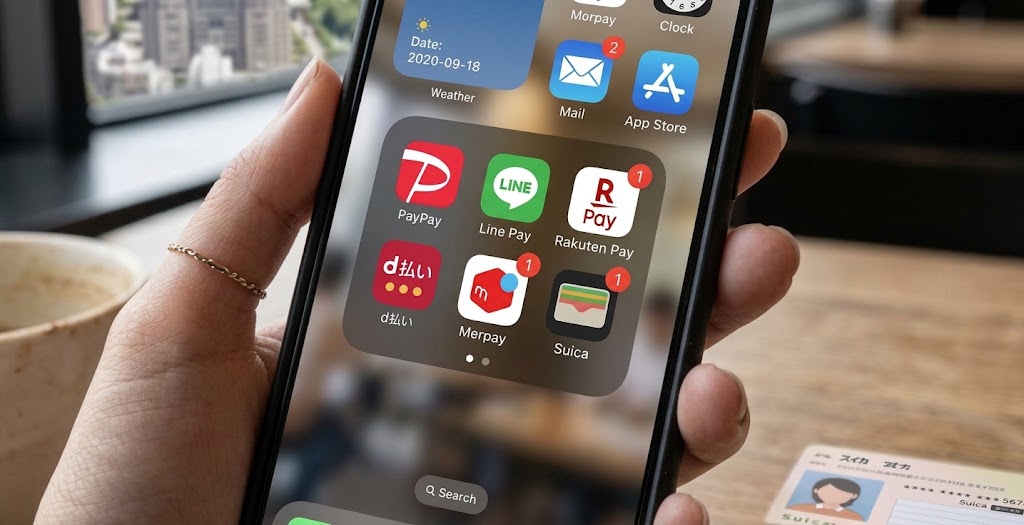
If you live in Japan, you have probably noticed that there is no single "best" way to pay. Walk into a convenience store and you may be able to pay with cash, a credit card, a transit IC card, or a QR payment app. Each option has different rewards, fees, limitations, and places where it can be used.
The question is not which payment method is the most modern. The question is which one actually gives you the best value over time.
This guide compares the main payment methods used in Japan and explains where each one can make sense.
The Four Main Payment Options
Most foreign residents end up using some combination of these four:
| Method | Examples |
|---|---|
| Cash | Physical Japanese yen |
| Transit IC cards | Suica, PASMO, ICOCA, manaca |
| QR code payments | PayPay, Rakuten Pay, d Barai, au PAY |
| Credit cards | Rakuten Card, EPOS, SMBC and others |
Each has a different approach to fees, rewards, convenience, and acceptance.
Cash: The Simple Baseline
Cash is still widely accepted in Japan, particularly at smaller businesses and places that do not support cashless payments.
Advantages
- Widely accepted
- No fee for making an ordinary cash purchase
- No account or app is required at the point of payment
- Works even when your phone battery is dead or a payment app is unavailable
- Useful as a backup for businesses that do not accept cashless payments
Disadvantages
- No built-in rewards or points
- You need to carry physical money
- ATM withdrawal fees may apply depending on the bank, ATM, and time
- Cannot be used for online purchases
Real cost
The purchase itself normally has no payment fee, but obtaining cash can sometimes involve an ATM fee. You also give up the points or rewards that some cashless methods offer.
When it makes sense
Cash remains useful for small businesses, markets, some restaurants, emergencies, and situations where cashless payment is unavailable.
It is also worth keeping some cash available even if you normally pay electronically.
Transit IC Cards: The Convenience Default
Suica, PASMO, ICOCA, and other transit IC cards are primarily designed for transportation, but they can also be used at many participating convenience stores, vending machines, restaurants, and retailers.
Mobile versions can offer additional functionality compared with physical cards, including different ways to recharge and, depending on the service and setup, access to points programs.
Advantages
- Extremely convenient for trains and buses
- Fast for small purchases
- Accepted at many participating retailers and vending machines
- No annual fee for ordinary stored-value use
- Mobile versions can be recharged electronically
Disadvantages
- Acceptance is not universal
- Stored-value cards have balance limits
- Rewards depend on the specific IC card, registration, payment method, and eligible transactions
- An unregistered physical card can be difficult to recover if lost
- Different IC services have different rules
Real cost
There is normally no separate fee simply for using an IC card to make an ordinary purchase. However, the rewards you receive depend on the particular IC service and how you use it.
For example, registered Suica users can earn JRE POINT in certain eligible circumstances, so it is too simplistic to say that IC cards provide no rewards.
When it makes sense
IC cards are particularly useful for commuting and quick everyday purchases when convenience and speed matter more than maximizing rewards.
QR Code Payments: Where Promotions Matter
QR payment services such as PayPay, Rakuten Pay, d Barai, and au PAY compete heavily through points programs and promotional campaigns.
The important thing to understand is that the advertised reward rate is not necessarily the rate you will receive on every purchase.
Rewards can depend on:
- The payment service
- How the account is funded
- Your membership or user status
- The merchant
- The type of transaction
- Spending limits
- Current promotional campaigns
- Campaign registration requirements
Advantages
- Convenient for everyday purchases
- Many participating merchants
- Points and rewards programs
- Frequent promotional campaigns
- Can sometimes be combined with other points or payment programs
Disadvantages
- Reward rates can change
- Promotions may have eligibility requirements or spending limits
- Not every merchant accepts every QR payment service
- Requires a compatible smartphone and functioning payment app
- It can take effort to track which campaigns are actually worthwhile
Real cost
For the consumer, an ordinary QR payment generally does not have a separate payment fee. The financial benefit comes from the rewards or discounts available for that particular transaction.
The important distinction is that promotional rewards are not guaranteed long-term savings.
A campaign offering an unusually high reward rate may be excellent for a limited period, but you should not assume that the same rate will continue indefinitely.
When it makes sense
QR payments can be useful if you are willing to take advantage of eligible promotions and points programs.
For someone who does not want to monitor campaigns, however, a consistent credit-card reward rate may be easier to manage.
Credit Cards: The Predictable Rewards Option
Credit cards are widely useful in Japan, particularly for larger purchases, online shopping, hotels, travel, and merchants that do not accept cashless alternatives such as IC cards or QR payments.
Many Japanese-issued cards offer points or other rewards, although the actual rate varies by card and transaction.
Advantages
- Widely accepted
- Useful for online purchases
- Useful for larger transactions
- Many cards offer points or other rewards
- Some cards offer additional benefits such as travel insurance or purchase protection
- Responsible use of Japanese credit products creates credit information that can be relevant to future credit applications
Disadvantages
- Some cards have annual fees
- Rewards vary between cards
- Credit approval is required
- Carrying an unpaid balance can result in interest charges
- Foreign-issued cards may have foreign-transaction or currency-conversion fees when used in Japan
Real cost
Many Japanese credit cards have no annual fee, while others charge an annual fee. Reward rates also vary.
For example, if a card effectively provides 1% in rewards and you spend ¥100,000, the rewards would be approximately ¥1,000. That is an example, not a universal credit-card reward rate.
If you carry a balance and pay interest, the interest cost can easily outweigh any rewards you receive.
When it makes sense
Credit cards are particularly useful when you want predictable rewards without having to monitor individual QR-payment campaigns.
They are also convenient for online purchases, travel, recurring payments, and larger transactions.
The Real Comparison: What You Actually Get Back
The math is not as simple as choosing whichever payment method advertises the highest reward percentage.
Consider someone spending ¥100,000 per month.
| Method | Monthly spending | Potential benefit |
|---|---|---|
| Cash | ¥100,000 | No purchase rewards |
| Suica/PASMO | ¥100,000 | Depends on the IC service and eligible transactions |
| PayPay or another QR service | ¥100,000 | Depends on the current reward program and eligible promotions |
| Credit card | ¥100,000 | Example: ¥1,000 at an effective 1% reward rate |
This is why there is no honest universal answer such as "PayPay always saves the most."
A QR campaign can temporarily provide a better return than a normal credit card, while a credit card may provide a more consistent benefit over the long term.
IC cards can also provide points or other benefits in qualifying situations.
The best method depends on the specific card, app, IC service, and promotion you are actually using.
The Hidden Cost: Using a Foreign-Issued Card in Japan
Foreign residents should pay particular attention to the difference between a Japanese-issued card and a card issued in another country.
If you use a foreign-issued card for purchases in Japan, your card issuer may charge a foreign-transaction or currency-conversion fee when the Japanese-yen transaction is converted into your card's billing currency.
For example, a card offering 1% rewards may not actually save you money if the issuer charges a higher fee for foreign-currency transactions.
Before relying on a foreign-issued card in Japan, check:
- Foreign-transaction fees
- Currency-conversion fees
- The exchange rate used by the issuer or card network
- Whether rewards apply to foreign-currency transactions
- Whether the card charges an annual fee
If you are living in Japan long-term, comparing these costs can be more important than simply looking at the advertised rewards rate.
Where Each Method Is Actually Accepted
Acceptance varies by merchant, so relying on only one payment method can be inconvenient.
Cash
Widely accepted, including at many small businesses and establishments that do not support cashless payments.
IC cards
Commonly accepted on trains and buses and at many convenience stores, vending machines, and participating retailers.
QR payments
Accepted at many participating restaurants, convenience stores, retailers, and online services, but acceptance varies by service and merchant.
Credit cards
Widely accepted at larger retailers, hotels, restaurants, online stores, and other businesses, but some smaller businesses may accept only cash or specific cashless methods.
This is why many people living in Japan use more than one payment method.
What Actually Saves You Money?
There is no single payment method that is always cheapest.
If your priority is simplicity
Cash and a transit IC card can cover many everyday situations without requiring you to monitor reward campaigns.
If your priority is maximizing rewards
QR-payment promotions can provide attractive rewards when you qualify for them. However, you need to check the conditions, limits, and duration of each promotion.
A rewards credit card can provide a more predictable return without requiring you to track campaigns.
If your priority is building a Japanese credit record
Using Japanese credit products responsibly can create credit information that may be considered when you apply for credit or loans in the future.
Credit information is not the same thing as a single universal "Japanese credit score," so having a credit card does not guarantee approval for future borrowing.
If your priority is avoiding foreign-currency fees
If you use a card issued outside Japan, check its foreign-transaction and currency-conversion fees before using it for Japanese-yen purchases.
The Bottom Line
Paying in Japan is not about choosing one payment method and using it for everything. It is about choosing the method that gives you the best combination of acceptance, convenience, rewards, and cost for each situation.
- Cash remains one of the most widely accepted options and normally has no payment fee, but offers no purchase rewards.
- Transit IC cards are extremely convenient for transportation and small purchases, with rewards depending on the specific service and eligible transactions.
- QR payments can provide attractive rewards, particularly during promotions, but those rewards can change and may have conditions or limits.
- Credit cards can provide consistent rewards and are particularly useful for online purchases, travel, and larger transactions.
- Foreign-issued cards should be checked for foreign-transaction and currency-conversion fees before being used extensively in Japan.
For most foreign residents, the practical solution is not to choose only one. Keep some cash available, use an IC card for transportation and quick purchases, take advantage of worthwhile QR promotions when appropriate, and use a credit card when its rewards and acceptance make it the better option.
For personalized assistance with Japanese tax procedures, resident tax, pension matters, or other administrative issues, contact HSB JAPAN for a professional consultation.