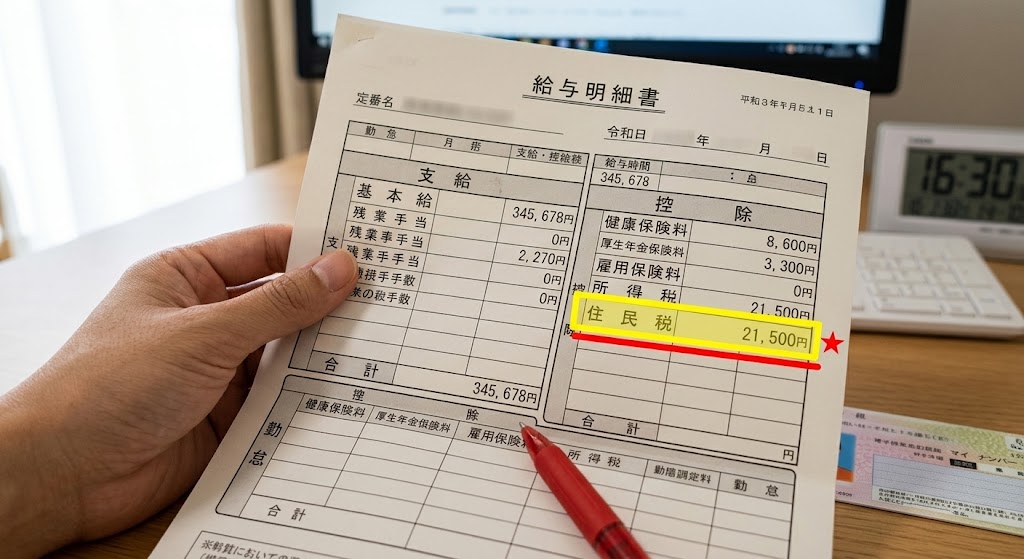
Have you noticed that your take-home pay in Japan can decrease during your second year of working, even though your salary has not changed?
For many foreign workers, the reason is resident tax (Juminzei). Unlike income tax, which is generally withheld based on your current earnings, resident tax is calculated using your income from the previous calendar year. This timing difference can catch newcomers by surprise.
Depending on your income and circumstances, resident tax may reduce your monthly take-home pay by thousands or tens of thousands of yen. However, the amount varies, and not everyone will owe resident tax in their second year.
Here is how the system works, when payroll deductions usually begin, and what you should know to avoid an unexpected bill.
1. Why Your Take-Home Pay May Drop in Your Second Year
Japan calculates resident tax primarily using your income from the previous calendar year. Your municipality generally determines whether you owe resident tax based on whether you had an address in that municipality on January 1 and whether your previous-year income meets the applicable requirements.
This creates a timing difference for people who have recently arrived in Japan.
Example: Arriving in Japan in June 2025
Suppose you arrived in Japan in June 2025 to start working.
- January 1, 2025: You were not yet living in Japan, so you generally would not owe Japanese resident tax for fiscal year 2025 based on your 2024 income.
- During 2025: You earn a salary in Japan. Income tax and other applicable deductions may already be taken from your monthly pay.
- January 1, 2026: You are living in Japan. Your municipality considers your 2025 income when determining your resident tax liability for fiscal year 2026.
- June 2026: If you meet the requirements for resident tax, payroll deductions will generally begin around this time if your employer collects the tax through your salary.
The result is that your take-home pay may decrease in June 2026 even if your gross salary remains unchanged.
Important: This is an example, not a rule that everyone pays no resident tax during their first year. Your actual liability depends on your residence circumstances, previous-year income, and applicable exemptions and thresholds.
2. How Much Is Resident Tax in Japan?
Resident tax is generally made up of two components:
- Income-based levy: Usually calculated at a combined rate of approximately 10% of the applicable taxable income, subject to the relevant municipal and prefectural rules.
- Per-capita levy: A fixed annual amount that generally applies to people who meet the relevant requirements, regardless of how much income tax they pay.
The income-based portion is commonly described as 6% municipal tax and 4% prefectural tax. However, the precise calculation can vary because of local rules, deductions, tax credits, and other adjustments.
There is also a national Forest Environmental Tax (Shinrin Kankyozei) of ¥1,000 per year, collected through the resident-tax system from fiscal year 2024 onward for people subject to it. This national tax should not be confused with the municipal and prefectural resident-tax levies themselves.
The fixed portion of resident tax is often around ¥4,000 per year in total under the standard framework, plus the ¥1,000 Forest Environmental Tax. Local additions or other adjustments may affect the actual amount.
A simplified calculation
Suppose your applicable taxable income for resident-tax purposes is ¥3,000,000.
A simplified estimate of the income-based portion would be:
¥3,000,000 × 10% = ¥300,000
If the applicable fixed levies and Forest Environmental Tax bring the annual total to approximately ¥305,000, that would average about ¥25,400 per month over 12 months.
This is only an illustration, not a prediction of your actual bill. Your gross annual salary is not the same as your taxable income. Employment-income calculations, deductions, exemptions, tax credits, and other adjustments affect the final amount. The actual tax assessment issued by your municipality determines what you owe.
3. When Does Resident Tax Start Being Deducted From Your Salary?
For employees whose resident tax is collected through payroll, the annual collection period generally runs from June through the following May.
The process usually works as follows:
- By January 31: Employers generally report employees' previous-year salary information to the relevant municipality.
- Around May: The municipality sends the resident-tax determination and collection information to the employer.
- From June: The employer generally begins deducting the assessed resident tax from the employee's salary.
- Through the following May: The employer continues collecting the monthly installments.
The exact dates for receiving notices and processing deductions can vary.
For example, resident tax for fiscal year 2026 is generally based on income earned during calendar year 2025. If it is collected through payroll, deductions usually run from June 2026 through May 2027.
What if you change jobs?
Changing employers does not automatically cancel your resident-tax liability.
Depending on the timing and arrangements, your remaining tax may be transferred to your new employer for payroll collection. If that does not happen, you may need to pay using municipal payment slips or another collection method.
Check with your current employer, former employer, or municipality to confirm how the remaining balance will be handled.
4. Why the Drop Can Feel So Sudden
The issue is the timing of the tax, not necessarily a reduction in your salary.
When you first begin working in Japan, resident tax based on your Japanese income from the previous calendar year may not yet be collected. Once the next fiscal year's collection period begins, the deduction can appear in your payslip.
Your monthly take-home pay can therefore decrease even if:
- Your gross salary has not changed.
- Your employment contract remains the same.
- Your income-tax withholding has not increased.
- You have not received a raise or bonus.
The effect depends on your earnings and tax circumstances. Some people will see a noticeable reduction; others may owe little or no resident tax because of their income level or applicable exemptions.
The practical lesson is to budget for resident tax before your first payroll deduction begins. Do not assume that your initial take-home pay will remain the same indefinitely.
5. What Happens to Resident Tax If You Leave Japan?
Leaving Japan does not automatically eliminate resident tax that you owe.
Your situation depends on your departure date, whether you are liable for the relevant fiscal year's tax, and how much has already been paid.
Leaving between January 1 and April 30
If you leave your job and Japan during this period, the remaining resident tax being collected through payroll is generally subject to lump-sum collection from your final salary or retirement allowance. However, if those payments are insufficient, you may need to arrange another way to pay the outstanding amount.
Leaving between June and December
Depending on your circumstances, you may be able to request lump-sum collection of the remaining amount from your salary. If payroll collection does not settle the balance, you must arrange payment through the applicable municipal process.
There is another important point: if you were in Japan on January 1 and meet the requirements for resident tax, your municipality may issue a new assessment in June based on your previous calendar year's income—even if you leave Japan before the notice arrives.
Before departure, check with your municipality or employer to confirm what you owe and how it will be collected. If you will be outside Japan when a tax notice arrives, you may need to appoint a tax representative (Nozei Kanrinin) to receive notices and handle payment procedures on your behalf.
For a more detailed explanation of departure procedures, see our related guide: Leaving Japan Between January and June? How to Handle Your Resident Tax Bill.
Unresolved tax obligations can create administrative complications and may be relevant in certain immigration procedures. However, an unpaid resident-tax bill does not automatically mean that every visa renewal will be refused. It is best to settle your obligations or arrange payment properly rather than leave them unresolved.
6. How to Prepare for Your Second Year in Japan
A few simple steps can help you avoid being caught off guard.
1. Budget for resident tax early.
When planning your monthly expenses, allow room for a possible resident-tax deduction beginning the following June. The amount depends on your income and circumstances.
2. Check your payslip.
Look for a deduction labelled Juminzei. If your take-home pay changes unexpectedly, compare your payslips and ask your employer which deduction changed.
3. Keep your municipal notices.
Your resident-tax determination notice or payment slips can help you understand the assessed amount, payment schedule, and collection method.
4. Confirm what happens when you change jobs.
Ask whether the remaining tax will be transferred to your new employer or whether you must pay it separately.
5. Arrange your taxes before leaving Japan.
If you plan to leave the country, confirm your outstanding balance, payment arrangements, and whether you need a tax representative.
Conclusion: Plan for Resident Tax Before It Starts
A reduction in take-home pay during your second year in Japan can be surprising, especially when your salary has not changed. In many cases, resident tax is the reason: it is calculated using previous-year income and is generally collected from June through the following May.
The key is to understand the timing, budget for the possible deduction, and check your actual assessment rather than assume everyone pays the same amount.
If you are unsure how your resident tax should be handled, HSB JAPAN can help you understand the procedures relevant to your situation and identify the next steps. Your municipality determines your resident-tax liability, so any estimate should be checked against your official tax notice.
For personalized assistance with Japanese tax procedures, resident tax, pension matters, or other administrative issues, contact HSB JAPAN for a professional consultation.