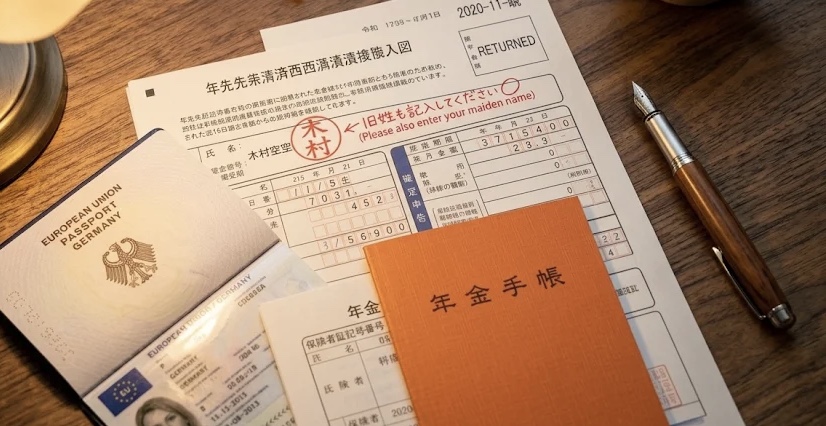
You have left Japan, or you are about to. You have read that you can claim back your Japanese pension contributions, downloaded the application form and sent it off. Then the envelope comes back—or worse, you receive a decision notice stating that your payment will not be made.
A rejected or returned application can cost you valuable time, particularly because the lump-sum withdrawal payment (dattai ichiji kin) has a strict two-year application deadline.
The Japan Pension Service does not approve every application simply because someone has left Japan and paid pension contributions. Applicants must satisfy seven eligibility requirements, and their supporting documents must establish that those requirements have been met.
Some problems result in an application being returned for correction. Others mean that the applicant is not legally entitled to receive the payment.
This article explains five common application mistakes, how the eligibility rules actually work and what you should check before submitting your claim.
First, Understand the Difference Between a Returned Application and a Non-Payment Decision
There is an important practical distinction between an application being returned because of incomplete documentation and a decision that the applicant does not qualify.
Returned application
If the Japan Pension Service identifies missing information, incomplete documents or inconsistencies, it may return the application and request corrections or additional information.
Examples include:
- Missing required attachments.
- Incomplete information on the application form.
- Incorrect bank account details.
- Missing or inconsistent pension identification information.
A returned application does not necessarily mean that you have permanently lost your right to claim. You may be able to correct the problem and resubmit, provided you still satisfy the eligibility requirements and applicable deadline.
Non-payment decision
A non-payment decision means that the Japan Pension Service has determined that the applicant does not satisfy the eligibility requirements.
Examples include:
- Still having an address in Japan when the application is received.
- Remaining covered by a Japanese public pension system.
- Having completed the 10-year qualifying period for an old-age pension.
- Having previously acquired entitlement to certain pension benefits.
The distinction matters because correcting a missing document cannot solve a substantive eligibility problem.
The Seven Eligibility Requirements
Before looking at the five mistakes, it is important to understand the official eligibility requirements.
According to the Japan Pension Service, you must satisfy all seven of the following conditions:
- You must not be a Japanese national.
- You must no longer be covered by the Japanese public pension system, including National Pension or Employees' Pension Insurance.
- You must have at least six months of qualifying coverage under National Pension or Employees' Pension Insurance. For National Pension, the relevant contribution requirements must also be satisfied.
- You must not have completed the 10-year qualifying period required for an old-age pension.
- You must never have acquired entitlement to certain pension benefits, including disability pension.
- You must no longer have an address in Japan.
- You must submit your application within two years of the relevant deadline-triggering date.
The two-year period generally runs from the date you cease to have an address in Japan. However, if you lose your pension-insured status while still having a Japanese address, the deadline is calculated from the first subsequent date on which you no longer have an address in Japan.
These requirements are separate from the documentation needed to process your application.
Mistake 1: You Still Have a Japanese Address When the Application Arrives
One of the most important requirements is that you must no longer have an address in Japan when the Japan Pension Service receives your application.
This catches people who have physically left Japan but have not completed the necessary municipal procedures.
When you leave Japan permanently, you should submit a moving-out notification (tenshutsu todoke) to your municipal office.
If you leave without doing this, your resident record (juminhyo) may remain active.
The problem is not simply that you have failed to notify the authorities that you have left. The issue is that you may still be regarded as having an address in Japan for the purpose of the lump-sum withdrawal eligibility assessment.
The Japan Pension Service can verify the deletion of your resident record through municipal information.
If you submitted your moving-out notification before departure, you generally do not need to provide separate documentation proving that you no longer have an address in Japan.
However, there are exceptions. For example, applicants whose pension records predate the introduction of the Japan Pension Service's management of foreign nationals' alphabetic names in July 2012 may need to submit additional evidence because the municipal deletion information cannot always be matched automatically.
If you did not submit the moving-out notification before leaving, contact your last municipality to establish how you can complete the procedure from overseas.
What to check before applying:
- Confirm that your moving-out notification was submitted.
- Check that your resident record has been deleted.
- Make sure the application gives your address outside Japan.
- If you did not submit a moving-out notification, establish what alternative documentation the Japan Pension Service will accept.
If you intend to submit the application before physically departing Japan, remember that the Japan Pension Service must receive it after the moving-out notification has been submitted and the deletion date of your resident record has passed.
Mistake 2: You Do Not Understand the Rules on Re-Entry Permits
Re-entry permits are an important consideration for foreign nationals leaving Japan.
However, there is considerable confusion about how they affect eligibility for the lump-sum withdrawal payment, particularly following the 2025 pension reform.
Under the rules currently in force, leaving Japan with a valid re-entry permit does not automatically prevent you from claiming the lump-sum withdrawal payment.
The important distinction is whether you have submitted a moving-out notification.
If you submit a moving-out notification before leaving Japan:
Your resident record is deleted, and you can generally apply for the lump-sum withdrawal payment after leaving Japan, even if you hold a valid re-entry permit or special re-entry permit.
If you leave without submitting a moving-out notification:
You may continue to be treated as covered by the National Pension system during the validity of your re-entry permit.
In that situation, you cannot claim the lump-sum withdrawal payment until the relevant coverage has ended.
What Changed Under the 2025 Pension Reform?
The Pension System Reform Act passed in 2025 introduced a future restriction concerning re-entry permits.
Under the amendment, foreign nationals who leave Japan with permission to re-enter will not be able to claim the lump-sum withdrawal payment while that permission remains valid.
However, this provision has a separate commencement date to be determined by Cabinet Order within four years of the legislation's promulgation.
It should not be confused with the existing eligibility rules.
As of November 9, 2026, the published Japan Pension Service application guidance continues to explain the existing distinction concerning moving-out notifications and re-entry permits.
Applicants should check the commencement date of the new provision before applying, particularly if they intend to leave Japan with a re-entry permit.
What to check before applying:
- Confirm whether you submitted a moving-out notification.
- Check whether your Japanese resident record has been deleted.
- Confirm whether you hold a valid re-entry permit.
- Check the commencement status of the 2025 legislative amendment.
Do not assume that surrendering your residence card or residence status is a substitute for completing the municipal moving-out procedure.
Mistake 3: Your Basic Pension Number Is Missing or Cannot Be Verified
The Basic Pension Number (kiso nenkin bango) identifies your pension record.
It is essential for processing your lump-sum withdrawal application because the Japan Pension Service uses it to establish your pension enrollment history and calculate the amount payable.
The application form requires you to enter this number.
You must also attach documentation establishing your Basic Pension Number.
Acceptable documentation includes:
- Basic Pension Number notification (kiso nenkin bango tsuchisho).
- Pension handbook (nenkin techo).
- Other documentation that establishes your Basic Pension Number.
If you have lost your pension handbook or cannot find your Basic Pension Number notification, do not guess the number or submit an application with incomplete information.
Contact the Japan Pension Service or the pension office responsible for your record to establish how you can obtain confirmation of your number.
You should resolve this issue before submitting your application.
What to check before applying:
- Locate your Basic Pension Number notification or pension handbook.
- Confirm that the number is entered correctly on the application.
- Attach the required supporting documentation.
- If you have lost your documents, contact the Japan Pension Service before submitting your claim.
Remember that the Basic Pension Number and the symbol number (kigou bango) associated with an older pension handbook are not necessarily the same. Follow the current application instructions when completing both fields.
Mistake 4: Your Bank Account Information Does Not Meet the Requirements
The Japan Pension Service requires documentation confirming that the bank account designated to receive your lump-sum withdrawal payment belongs to you.
Simply writing an account number on the application form is not sufficient.
You must attach documentation, such as a certificate issued by your financial institution, confirming the required banking information.
The documentation must establish:
- Bank or financial institution name.
- Branch name.
- Branch location.
- Account number.
- Account holder's name, confirming that the account belongs to the claimant.
Several problems can arise.
The Account Holder's Name Does Not Match
The account must belong to the person claiming the lump-sum withdrawal payment.
The name entered on the application must accurately match the name registered with the financial institution.
For example, using only a middle-name initial when the bank has registered the full middle name can cause problems with the transfer.
Name changes resulting from marriage or other circumstances can also require additional documentation to establish that the account belongs to the claimant.
Your Bank Cannot Receive the Payment
Not every financial institution can receive the lump-sum withdrawal payment.
Japan Post Bank (Yucho Ginko) cannot be used for this purpose.
Some internet-only banks are also unable to receive these payments.
If you intend to use a Japanese bank account, confirm directly with the financial institution that it can accept the transfer.
Japanese Bank Accounts Have an Additional Requirement
If you designate a Japanese financial institution as your receiving account, the account holder's name must be registered in katakana.
An account registered only under a romanised name may therefore fail to satisfy the requirements for a Japanese receiving account.
If you designate an overseas bank account, you must also provide the appropriate international banking information, including the SWIFT/BIC code and IBAN where applicable.
What to check before applying:
- Obtain acceptable bank documentation confirming the required account information.
- Confirm that the account belongs to you.
- Make sure the account holder's name matches the bank's registered information.
- Check that the financial institution can receive the payment.
- If using a Japanese bank, confirm that the account name is registered in katakana.
- If using an overseas bank, check the SWIFT/BIC and IBAN requirements.
Pay particular attention to the bank details because an incorrect account number or name can prevent the transfer even after your pension claim has been approved.
Mistake 5: Required Attachments Are Missing or Incomplete
The Japan Pension Service specifies which documents must accompany the lump-sum withdrawal application.
Failing to provide the required attachments can delay processing or result in the application being returned.
The standard documentation includes four main categories.
1. Passport Copy
You must provide copies of the passport pages that establish:
- Your name.
- Date of birth.
- Nationality.
- Signature.
- Status of residence.
Make sure the relevant information is clearly visible and readable.
2. Proof That You No Longer Have an Address in Japan
Acceptable evidence can include:
- A copy of your deleted resident record (juminhyo no josho).
- A copy of the passport page showing your departure date.
- Other documentation establishing that you no longer have an address in Japan.
However, if you submitted your moving-out notification to your municipality before leaving Japan, separate documentation is generally unnecessary because the Japan Pension Service can verify the deletion information.
There are exceptions, particularly for certain older pension records where the applicant's name cannot be matched automatically.
3. Bank Account Documentation
You must attach documentation confirming the receiving financial institution, branch, account number and account holder's name.
Check that the information matches the details entered on the application form.
4. Basic Pension Number Documentation
Attach your Basic Pension Number notification, pension handbook or another acceptable document establishing your Basic Pension Number.
Inconsistent Information Across Documents
Another problem is inconsistencies between the application and supporting documents.
Examples include:
- Different spellings of your name.
- Incorrect dates of birth.
- Bank account details that do not match the attached certificate.
- An incorrect overseas address.
- Missing information in the application form.
These inconsistencies can prevent the Japan Pension Service from verifying your identity or processing the payment.
The application instructions also require the claimant's name and overseas address, as well as bank information, to be entered correctly. The bank account information must match the supporting documentation.
What to check before applying:
- Use the latest official application form.
- Follow the current attachment requirements.
- Check every page of your passport that contains the required information.
- Confirm that your bank documentation is complete.
- Attach your Basic Pension Number documentation.
- Compare all names, dates and account details across the documents.
- Make sure every required section of the application form is completed.
Do not rely exclusively on older online guides or application checklists. The Japan Pension Service has updated its forms and instructions, including changes introduced in February 2025.
One More Condition That Cannot Be Fixed After the Fact: The 10-Year Rule
Apart from the five application mistakes above, there is another eligibility condition that can result in a non-payment decision.
If you have completed 120 months (10 years) of qualifying pension coverage, you cannot claim the lump-sum withdrawal payment.
This is because you have already fulfilled the minimum qualifying period for a Japanese old-age pension.
Importantly, the 10-year qualifying period is not calculated exclusively from the number of months during which you personally paid pension contributions.
Depending on your circumstances, qualifying periods can include:
- National Pension contribution periods.
- Employees' Pension Insurance coverage periods.
- Qualifying periods during which contributions were exempted.
- Applicable periods counted as gassan taisho kikan, commonly called contribution-free or supplementary qualifying periods.
This distinction matters because someone who believes they have fewer than 10 years of contributions may actually have completed the 120-month qualifying period.
For example, someone with eight years of Employees' Pension Insurance coverage may have additional qualifying periods that bring their total to 10 years.
The lump-sum withdrawal payment is therefore not available simply because you have personally paid contributions for fewer than 120 months.
What to check before applying:
Contact the Japan Pension Service or review your pension record to establish your total qualifying period, including applicable exempted and supplementary periods.
If you have already fulfilled the 10-year qualifying period, claiming a lump-sum withdrawal payment is not an option.
What to Do If Your Application Is Returned
Receiving a returned application does not automatically mean that you have lost your right to claim.
The first step is to read the accompanying explanation carefully and identify exactly what information or documentation is missing.
Then:
- Correct the identified problem.
- Obtain any missing documents.
- Check the entire application again, not just the section identified in the return notice.
- Follow the instructions concerning resubmission and any documents that must accompany the corrected application.
- Make sure you still satisfy the eligibility requirements.
Most importantly, keep track of the two-year application deadline.
A returned application does not automatically extend the statutory deadline.
If the correction process takes too long and the deadline expires, you may lose the opportunity to claim the payment.
If you are approaching the deadline, contact the Japan Pension Service immediately rather than waiting for additional paperwork to be prepared.
The Pre-Submission Checklist
Before mailing your lump-sum withdrawal application, confirm the following:
- You are not a Japanese national.
- You are no longer covered by the Japanese public pension system.
- You have at least six months of qualifying pension coverage.
- You have not completed the 120-month qualifying period for an old-age pension.
- You have never acquired entitlement to a disqualifying pension benefit, including disability pension.
- You no longer have an address in Japan.
- You are within the applicable two-year application deadline.
- Your moving-out notification has been submitted and your resident record has been deleted, where applicable.
- You have checked the rules concerning any valid re-entry permit.
- Your Basic Pension Number is entered correctly and the supporting document is attached.
- Your bank account documentation contains all the required information.
- Your financial institution can receive the payment.
- Your passport copy contains the required identification information.
- All supporting documents are complete and consistent.
- You are using the latest application form and instructions.
Most application problems can be avoided by checking the eligibility requirements and documentation before submitting the claim.
However, it is important to distinguish between a correctable paperwork problem and an eligibility condition that prevents payment altogether.
Need Help With Your Japanese Pension Refund?
The Japanese pension system has specific eligibility requirements, documentation rules and deadlines that can be difficult to navigate, particularly after leaving Japan.
HSB JAPAN can assist with understanding the lump-sum withdrawal requirements, reviewing application documentation and determining whether your circumstances meet the relevant eligibility conditions.
If you are unsure whether you qualify, or want to avoid unnecessary delays caused by incomplete documentation, contact HSB JAPAN for a professional consultation.